Wednesday, September 18, 2013

Blossom Dearie - Simply Volume VI (USA, 1983)


Yes I know, the name of the artist is ridiculous.... but listen to the music before passing judgement.

Long long ago when I was a university student listening to American jazz and fusion I found this as a cassette in a nearby record store downtown a few minutes' walk from the apartment I shared with my brother.  Over the next few years I listened to it over and over again and learned to play most of the songs on the piano.  On a holiday to New York City some years later that I planned around a performance of Blossom either at the Village Vanguard or the Blue Note, I don't remember which, I ran up to her after the set and told her how much I loved this record and the ones before and after...  her only comment?  "then maybe buy some more of these CDs and cassettes here" to which I answered, "but I have them all already," whereupon she turned her back on me without another word.
 
How could I have foreseen that the person who sang like an angel on my favourite jazz records of my teen years turned out to be a mercenary only interested in making me buy a few dumb cassettes for a few dollars?  I was crushed, and probably had one too many 'singapore slings' that night at the jazz club.   Of course considering the stature of the musicians she worked with in her life (her earlier life that is, by the time I saw her she must have been about 60), the idolatry of a univ. student a third her age would have seemed bizarre I guess especially since my pens-in-shirt-pocket geekiness and accompanying girlfriend would have made me a most undesirable and inappropriate boytoy.

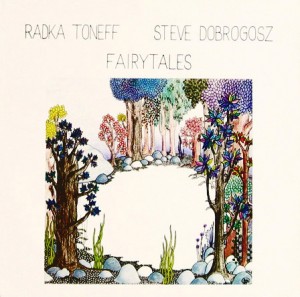
I was reminded of her when listening to Radka Toneff,  because she did a version, on Fairytales, of one of Blossom's best compositions: Long Daddy Green (about the American dollar, of course).  The other fantastically beautiful record she did, similar to Fairytales in sparseness, is "Chez Wahlberg" -- just a masterpiece of delicate emotions and poetry, covering almost a full range in human relationships and social interactions in one record, like a Russian novel.  To me this impossible to find record was her best album, and no one knows it-- how typical.

Listening to this again today I find the soft breeziness and sentimental loveliness, the heavenly, spacey Rhodes so typical of those beautiful happy and innocent days of the seventies and early eighties.  Of course it's all about nostalgia of childhood, those younger than me will feel the same way about eighties music, or nineties music.  Still, I would argue that objectively, there is something almost supernaturally beautiful about the music of the seventies (and to some extent sixties).

The best track by far is a duet she did with Bobby Dorough (remember him from Children of all Ages?) called "Bring all your love along" which I 've sung in courting many a female in my life.  (Thank god I'm past all that now.  Although my wife daily tells me the opposite, why is there no more courting anymore?  I love Woody Allen's answer to that: "because it's exhausting!")  I wonder why the amazing pop song "Answering Machine" never got off the ground as a radio hit.  As a sample I'll also include the astonishingly intricate composition, "I told you so," with its gorgeous Fender Rhodes.  Skip over track B4, a cover version of Billy Joel's atrocious medieval torture instrument, "Just the way you are," I could never figure out what bizarre lapse led to its being included on this record.


B2 "I Told You So" (Words and Music by Duncan Lamont)


A5 "Answering Machine" (Words and Music by Rupert Holmes)


Credits:
Bob Dorough - Guest Performance A5 and B5
Edward Remusat - Recording Engineer
Mike Renzi - Mentor and Additional Keys
Grady Tate - Drums
Jay Berliner - Guitar
Jay Leonhard - Bass
(Blossom plays most of the keyboards otherwise.)

Her huge discography:
http://www.discogs.com/artist/Blossom+Dearie

Tuesday, September 17, 2013

Scope I (Dutch Band, Made in Germany, Rights registered in Holland, 1974)


Absolutely a masterpiece of fusion-- it just don't get more masterly than this.  A poor mono rip has been circulating for some time that really didn't do it justice, so I had to purchase the record; please upgrade your copies to this new one.  They of course did another album called Scope II but it wasn't quite as good as this powerhouse.  I hope everyone reading knows this band already.  Briefly what we have here is the best ideas from seminal fusionauts Mahavishnu and Soft Machine in a very listenable but inventive and interesting package without silly frills like overlong solos, like the Heavy Joker with Max Leth jun I posted a long time ago but much better.  Of particular interest is the gorgeous Fender Rhodes, minimoog, and organ playing of Rik Elings, who composed most of the music.  However the guitarist, Rens Nieuwland, is not exactly a shabby player in this outfit-- not at all!

For those who haven't heard this yet, hang on to the handrails, because this is some of the most furious fusion those 'tired old Europeans' (to use Dick Cheney's phrase) have ever produced.  (Now the joke's on Dick of course since he can no longer travel to Europe for fear of being arrested for war crimes and put on trial at the Hague, but he can at least listen to this masterpiece from the privacy of his lead-lined basement bunker 50 feet underground....as he remembers 'Yesternight's Dream:' [track A4] the New American Empire, now a matter made merely of memory alone...)

Yes, I know, more US-bashing.  But bear in mind I've also indulged in Euro-bashing:
http://prognotfrog.blogspot.ca/2012/06/free-fair-holland-1978.html
and singled out the obsessive-compulsive Germans for particular satire often enough...


CREDITS:
Bass, Grand Piano, PercussionErik Raayman
Drums, PercussionHenk Zomer       
Electric Piano [Fender Rhodes], Organ [Hammond], Grand Piano, Flute, Synthesizer [Minimoog]Rik Elings
EngineerVolker Heintzen
GuitarRens Nieuwland
ProducerJochen Petersen, Scope (15)

And to think this record is almost 40 years old now!
Kayak...etc.:


Yesternight's Dream:


Monday, September 16, 2013

Radka Toneff (Norway, 1977-1982)


Straightaway I'm going to mention this is not a download post, because these records are easily available now as CD copies, or even as cheap LPs.

A friend recently introduced me to the music of this amazing Norwegian singer, whose style might be described as a mid-seventies jazzy singer-songwriter (think Joni Mitchell during the "Blue" period or Roberta Flack in the early seventies).  I have never heard such a beautiful and emotional triplet of albums since I and so many others 'rediscovered' Nick Drake way back in the 80s-90s, and Nina Simone before him.  Although his style was folk, and hers singer-songwriter, they are very similar emotionally and not surprisingly both committed suicide.

Back when I was in high school I fell in love with an American poet called Sylvia Plath, who I still adore.  How, at that time, could I possibly have known that in Norway a brilliant musician called Radka Toneff had set her poem "The Lorelei" based on a Germanic myth, to the most amazing progressive melodies?  This is one reason I thank god for the internet, without which me hearing Norwegian albums would have been impossible.  But I know that if I had heard her version of this as a kid I would have been blown away even back then not just by the musical compositional brilliance, but by the way she has put the whole soul of the poem to music with the strings, the piano, the harmony vocals at the end: "Stone, stone, ferry me down there."

"Words don't come easy to me, my feelings show in my face,  but when I sing to you, I sing to you, and no one else, no one else."
Every song is personalized in the most emotionally devastating way.  Her rendition of the old Jimmy Webb "The Moon is a Harsh Mistress" (he stole the title from a sci-fi novel by Heinlein but turned it into a gorgeous lost-love song) is also out of this world.  How many times have I said the same, this is the only taste of what heaven is like on this world that I will ever experience.
http://www.youtube.com/watch?v=ZI28ivLWJtw

Like Nick Drake the last album is stripped down and austere featuring only singing and amazing acoustic piano, almost a suicide note in fact, as the last song testifies:  "I read my sentence" (a poem this time by another favourite, Emily Dickinson.)

For more biographical infos check out wiki as usual:
http://en.wikipedia.org/wiki/Radka_Toneff


THE LORELEI:
http://www.youtube.com/watch?v=dGBOKNHSWOU
(Listen to the song and read the poem, since her English at times is difficult to understand.  I'm pretty sure this poem is about the urge to kill oneself, symbolized by the siren-like Lorelei which calls sailors to their death on the rocks below her, which Sylvia Plath also succumbed to in the end.)


It is no night to drown in:
A full moon, river lapsing
Black beneath bland mirror-sheen,

The blue water-mists dropping
Scrim after scrim like fishnets
Though fishermen are sleeping,

The massive castle turrets
Doubling themselves in a glass
All stillness. Yet these shapes float

Up toward me, troubling the face
Of quiet. From the nadir
They rise, their limbs ponderous

With richness, hair heavier
Than sculptured marble. They sing
Of a world more full and clear

Than can be. Sisters, your song
Bears a burden too weighty
For the whorled ear's listening

Here, in a well-steered country,
Under a balanced ruler.
Deranging by harmony

Beyond the mundane order,
Your voices lay siege. You lodge
On the pitched reefs of nightmare,

Promising sure harborage;
By day, descant from borders
Of hebetude, from the ledge

Also of high windows. Worse
Even than your maddening
Song, your silence. At the source

Of your ice-hearted calling --
Drunkenness of the great depths.
O river, I see drifting

Deep in your flux of silver
Those great goddesses of peace.
Stone, stone, ferry me down there.

Radka Toneff committed suicide on October 21, 1982 at the age of 30.
I hope the beauty of this amazing artist remains a part of our culture for ever!

"Shy like a child, she is... her glance, her story that never was told...
Say something nice to her, don't turn your back on her..."
http://www.youtube.com/watch?v=5NxJTV1y52s


Now I'll open the floor up to requests, if anyone wants some reups from the recent past-- that is, the last 2-3 years since I've been here.

Wednesday, September 11, 2013

Walkie-Talkies - Surveillance (UK, 1980) [REUP]

http://prognotfrog.blogspot.ca/2012/02/walkie-talkies-surveillance-1980-uk.html

I know this was requested a few times, so I'll repost it here and in the original from Feb. 2012.
I gotta say I really loved this record, done in that smooth british pop-prog style only they could do, there is enough progressiveness here to make me happy, enough approachability to make it listenable in decent company.  There is involvement from some famous Canterbury players as I mentioned particularly the awesome signer Amanda Parsons (who I could fall in love with for her voice alone).

"Rob Spensley, a rock solid bassist, and Dave Fuller, an acoustic guitarist who succeeds in sounding power-assisted, gather around them a number of distinguished hired hands to produce music that touches several bases. Along the way you get high-flyin' harmonies, spacey synth sounds, healthy dollops of jazz and even a smattering of Police style reggae, performed to a high standard. Even so it's unlikely to get within sniffing distance of the charts. Are all the groups from Guernsey as confusing as this ?"
One last comment, I'll sometimes post wav files as in this case, please use any free program such as xrecode or cdex if you want to convert back into mp3, for ex. those who use mostly ipods to listen to music like myself really can't for practical reasons listen to lossless files, only mp3s.  On the other hand it's of course better to store the lossless somewhere so you don't have to listen to any inferior quality musical rip job.

Tuesday, September 10, 2013

Ricotti Albuquerque - First Wind (UK 1971) [REUPLOAD!!]


http://prognotfrog.blogspot.jp/2012/05/ricotti-albuquerque-first-wind-1971.html
I sold the record so I figured I might as well rerip it and reupload it.
Note that Frank Ricotti made one interesting library album called "Vibes" that features at least a couple of progressive tracks, though the remainder is ordinary library in my opinion, while de Albuquerque made two classic pop-prog albums in the 70s, Stalking the Sleeper and We may be cattle, etc., both of which I really love, featuring that typical british beatlesian smooth produced arrangement with unusual melodies, etc.

Monday, September 09, 2013

Sorry (FRA, 1978)


http://www.discogs.com/release/1191233
http://rateyourmusic.com/artist/sorry__70s_
Another Massiera project, though I'm confused why his records are so sought after, other than the Working Progress one posted earlier this year, I find his output very very uneven.  In this outing from 1978 Ives and Ruiz the two composers create mostly hard rock with a tiny bit of progressive.  I'm not sure why it's in so many collectors' collections.  Ratings as you'd expect are all over the place.  And the cover?  ouch

Wednesday, September 04, 2013

Orchester Roland Schneider / Günter Lenz - Sound Motion (Germany, 197?, Library)


This will appeal to the library collectors out there.  Basically, it's half a good album, and I think everyone reading this will know right away which side is the recommended side.  I don't know much about the Orch. R. Schneider, which plays a typical easy listening styled library 'elevator music' on side one, the throwaway (perhaps the encylopedic discobasso, from whose store I bought this, could illuminate us further on the subject).   (Btw, the old 'muzak' that was the bane of shoppers everywhere, has now been replaced by the golden oldie hits of the beatles, the rolling stones, etc., and I hope I'm not the only one who absolutely detests this overuse of classic rock.)   In progressive circles we know Gunter Lenz (though we may not think we do) thanks to his many contributions to German progressive jazz, for ex., in Albert Mangelsdorff's Quintet, Dauner's Et Cetera, the Manfred Schoof Quintet, and the amazing post-Dzyan trio of Giger-Lenz-Marron whose first album long ago was posted here ("Beyond").  (The second one, "where the hammer hangs", was mostly free jazz with percussion, which is where Giger put his energy into afterwards.)

The music of Lenz on this record is quite progressive jazz and highly enjoyable.

Link up in a sec


Thursday, August 29, 2013

Checkpoint Charlie - Feuer und Flamme (GERM, 1982)


http://rateyourmusic.com/artist/checkpoint_charlie

Most of us probably remember how mutantsounds posted some of their amazing early albums, including their masterpiece "Krawall im Schweinstall" here:
http://mutant-sounds.blogspot.ca/2009/11/checkpoint-charlie-krawall-im.html
I then added "Durchsichtige" as a homage to them along with comments about communism and the bizarre romantic attitude Western Europe as a whole had towards it, at least until Pol Pot's experiment of radical communism in Cambodia came to light, which no one could really justify with a straight face though some at the time tried.
I have also in the past made fun of communism, a pastime which I find is strangely unpopular, although quite gratifying:
http://prognotfrog.blogspot.ca/2012/06/free-fantasy-1976.html
and here:
http://prognotfrog.blogspot.ca/2010/05/dobro-jutro-1980.html

Recently the impressive French scholarship in "The Black Book of Communism" could ensure there is no doubt in history that communism was one of the greatest tragedies humanity has ever endured or self-created.  How millions of people could have perished, not from resource scarcity, conflict, to enrich leaders, or environmental disaster, but merely to be sacrificed at the altar of an ideology-- is virtually impossible to believe.
Those millions died only because of an idea, an abstract conception of a better society.

When we consider the reductionism of science which for ex. physicists attest-- that all complex phenomena can be reduced to subatomic interactions-- I wonder how you really can explain in chemical or quantum terms how so many millions of humans died due to the ideas of one Karl Marx who thought a better society was possible when the proletariat overthrow their bourgeois oppressors and that this process could be hastened in various artificial ways.  Where do you find those atomic interactions exactly that led to  those actual physical individuals dying?  You'd have to follow a sequence starting in one philosopher's mind, Marx (and how do you explain the origin of his thought processes?) then proceed on to the power of printing, of education, of certain tyrannically-minded people, but even that isn't enough, since you are required to have the correct social zeitgeist to allow such an idea to take hold within an entire fertile society, in short, there isn't even the slightest hope you could follow such a chain of causation outside of the broad-stroke 'explanations' usually given by historical analyses.  Reductionism is simply not appropriate for explanatory power in the universe as a whole, with the level of complexity brought about by an 'intelligent' mind.  The fact that abstraction can influence actual physical processes can be demonstrated from the planetary climate changes we are bringing about via technology and abstract knowledge (rather than some bio-physical process).

Consider the case of China, in which Mao at one point in the sixties decided culture was useless and that all education should involve learning to be a peasant. Therefore everyone no matter how professionally educated had to farm.  When you hear about these ideas, you ask yourself, this couldn't really have happened.  But it did.  In Romania, Ceausescu decided he would abolish birth control to force the population to increase, the result was that most women abandoned their infants in orphanages, where hundreds of thousands of children were deprived of sensory stimulation and wound up in a developmentally delayed state.  He wasn't too concerned with overall social welfare.  Those orphans today are unproductive adults who are a burden to the state now that they have grown up…

Of course as we know in N. America there was the opposite attitude of paranoiac fear of communism which in its own way was equally extreme and childish.  As a result, Vietnam was defoliated with thousands of tons of dioxin, a substance so poisonous even micrograms in farmer's fields are frantically detoxified when they are found within the United States, or in parts per billions in small rivers.  Too bad those poor Vietnamese can't detoxify the tons they were exposed to in the "American War" -- oh sorry you know it here in the West as the "Vietnam War" (although I recently read the US government was generous enough to offer a few million dollars to help the clean up-- prob. the price of a few hazmat suits, for the American workers over there.)

When you ask those who suffered under the eastern regimes in Europe they are pretty adamant about the evils of communism and the corruption and hypocrisy they were forced to endure for so many years-- there was nothing romantic about it for the oppressed hungarians, polish, bulgarians, etc.  For them even socialism is a dirty word to be spat out.
How angry they would have been back in the seventies, to know that rock bands like this one were trying to start communist revolutions in France, in Germany, etc.

Musically though, I was happy to find this record because I always loved the hard guitar style of Checkpoint Charlie and the ingeniously progressive compositions they put together.  And this entry won't disappoint any of you who have a hunger for prog rock, despite the late year, because you will hear all the odd chord changes and tritonal riffs you've come to expect of the genre.  The only compromise for the times is a couple of songs with a definite but not overdone punkish drive.  There is an almost total lack of new wave influence, on the other hand.

Another question I always return to is this, to what degree did these anarchist communist political bands actually change the world or their national governing structures?  Hardly--  the eighties brought a tsunami of conservatism, deregulation, and naked blatant greed to the western world, that I've discussed endlessly in the past as well.  And those who fought for earth days in the seventies and the environment could hardly have foreseen that the eighties would be merely the beginning of the most desperate accelerating destruction of the natural world we live in, for the sake of short-term riches and materialism.  As so many have pointed out, our world economy is like a driver stepping on the gas harder and harder as he approaches a cliff he can't see.

I find it so incredibly sad that humanity to this day has never been able to find that balance between materialist, self-indulgent comforts versus the true conservative ideals (which today are called liberal) of abstinence, moderation, respect for our surroundings and preparations for our future and our children.  Will we ever find it?

Notice the cover has a matchstick book stuck to it with actual matches you can use to start anarchist fires in your local downtown.  Cool, or stupid?
At least the music is magnificent.


Thursday, August 22, 2013

Teo Macero and Bob Prince - What's New? (USA, 1956)


Teo Macero is one of my favourite jazz arrangers and composers.  In this early seminal album, he occupies side a to Bob Prince's side b, to create a fusion of modern classical music with jazz composition.  Unfortunately it was recorded in mono, though clearly stereo was available at the time, I suppose Columbia felt the music was so 'out-there' they didn't feel there was the need to make it a stereo recording.  Briefly I will run through Teo's spectacular career in jazz.

I first heard Teo in childhood from the 1980 compilation which was called just that, which absolutely threw me to the floor with the eerie combination of pop jazz, avant-garde music, classical influences, brilliant and unusual songwriting (as in 'Blues for Amy' one of those songs I might have listened to literally hundreds of times in my life) and then the peculiar tendency, which you will hear in this record, of combining sax (his own playing presumably) with accordeon for a kind of late-night film-noir french crime drama feel.  Selective discography:
http://rateyourmusic.com/artist/teo_macero
I draw your attention to 1968's Faces OST, which is wonderful on its own merits as a production in the heyday of American film (in my opinion), it's a very freudian-neurotic 'who' s afraid of virigina woolf' style emotional train-wreck (I say that in a positive sense lol) with John Cassavetes acting and directing.  Notable also is the soundtrack to 'Virus' which is shockingly still available as download online thanks to our colleague pollux.  "Acoustical Suspension" provided a wonderful mix of classical and jazz at a high level of composition, as did the amazing homage to Mingus, "Impressions of Charles Mingus" .  Unlike what one might expect there are no covers of Mingus compositions but only Macero's impressions of Mingus' feel.

Teo was partially responsible for my single favourite jazz album, Mingus' 1971 opus "Let my children hear music" which is absolute and utter genius, in which one hears all the torment and emotion and thought of a true late, great, genius, the beautiful Charlie Mingus, scored to orchestra by Teo.  The one album I would carry with me to the ends of time.  In the wiki bio you can read about how he contributed to some absolute masterpieces of jazz such as Miles' Kind of Blue and Bitches Brew, said to be the most popular jazz album of all time.
http://en.wikipedia.org/wiki/Teo_Macero

Let's go back to the album in question here, which was at the time labelled 'third stream' (vs. jazz and classical).  Here we get a good idea of how incredibly talented Teo was as a composer.  The back of the record features notes about all the songs, some are out and out atonal, even using the dodecaphonic scale (that is, each of the 12 tones is used once in a passage that sounds completely unmelodic, and is then fiddled with e.g. by reversing the order of the notes to provide a completely abstract melody), some have the aforementioned romantic sound of tenor sax on top of accordeon, a couple are recognizably jazz, but all are quite experimental, at least on the first Macero side of things.  I recommend you listen to the record while reading the notes, which I scanned adequately for this purpose.

I'll go into a bit of detail with one track called "Sounds of May", because it's so utterly unusual.  The first part, as described on the liner notes by Teo, consists of notes on the piano which were depressed without striking the ivories, so the strings were allowed to vibrate--by a sax being played on top of the strings! Later the sax notes themselves were removed, leaving only the sound of the strings playing their overtones under the influence of the ghostly saxes.  Truly this will sound odd, like a synthesizer/string mellotron/theremin combination.  You'll see what I mean.  A later part of the song then consists of a sung melody which is played again on top delayed several times, making the resultant total sound like a group of monks chanting.  At the end, one melody is played at half speed, whereupon the same is played half way thru at normal speed, on top. You get an idea of how much fun he was having composing this music.

On side b, the Bob Prince side of things, you'll get much more of that American swing style which I got tired of long ago, preferring the Euro-non-swinging style of jazz.  The highlight to me is the Ground Base or Bass song, which is interesting in its use of trumpet chords or riffs played in seconds on a very low register, giving the whole a dull and very odd sound.

It's wonderful what these talented guys were able to achieve in the days before electric and synthesizer instruments swept us all away into the garden of fusion eden.  I wish the time and effort they put into composition weren't so utterly lost. I saw that many of his old recordings and eighties materials are on sale now on amazon.com as mp3 downloads or as CDs, but of course, not this old mono recording.
http://www.amazon.com/Teo-Macero/e/B000APIM3M/ref=sr_ntt_srch_lnk_2?qid=1377199828&sr=8-2


http://www.theguardian.com/music/2008/feb/28/jazz.urbanmusic
" Daragh McCarthy writes: I first met Teo Macero five years ago at his apartment in New York when I filmed the first of many interviews about his life and work. It was a tiny apartment filled with photographs of himself and his friend Edgard Varèse, and several of the effects machines specially designed for him by the engineering department at CBS records. I once asked him what the key to his studio technique was. He struggled to find an answer before finally saying: "It's like E=mc squared. It's very simple really ... and then I use my ears.
In his last years Teo wrote music prolifically. He said the pain from his illness disappeared when he wrote. In his apartment, he would play every day on his Fender Rhodes electric piano. At his house in the Hamptons on Long Island, he played on his full-sized grand. He approached writing with urgency, determined to get stuff out and laid down for posterity."

Teo Macero died at the age of 82 on February 19th, 2008.


Macero's Sounds of May:    

 Bob Prince's Ground Base (Bass):        

Wednesday, August 14, 2013

Vasant Rai / Collin Walcott / Paul McCandless / Glen Moore / Dilip Naik ‎– Spring Flowers (USA, 1976)


Here's another record that should, like the previous entry, prove highly popular.  This time we are dealing with eastern music played by Vasant Rai, who is the composer for all tracks, backed up with such jazz luminaries as Colin Walcott and the amazing Oregonian Paul McCandless, the prime reason I bought this record.  Also I really loved the cover, which is odd but quite surreally gorgeous in that typical mid-seventies lsd-drippy way.  It's funny how that coleopteran, new-agey taste for sitar and indian music has dissipated in today's world -- is that good or bad?   I believe those spring flowers of which these meditation-mad maniacs spoke are now merely dried up flowers crumbling into dust in the hands of those of us who are attempting to perpetuate this musical legacy somehow into the future.  Will a delicate and beautiful, hard to appreciate album like German Iviron survive somehow into the coming upheavals of the future?  With uncharacteristic pessimism I don't see it as possible, though I would love to have a heart-to-heart with one of those dandelion-common optimists who believe in our future techno-success extending into colonizing other planets and even galaxies.  For my part every time I take my kids to the park with clearly marked "dogs must be leashed" signs and every five minutes someone laughs as their off-leash dog charges at my little ones and terrifies them, or every time I get in my car to drive to work and am cut off after each mile by some idiot with no regard for anyone else, I find less and less reason to believe in humanity's future.  As I've said so many times before, there are signs all around us that our society is on a breaking-down course at the moment, if one really cares to look instead of ostriching about: in the obvious financial senses, or socially, not just ecologically.  Is it really possible to reform our old democracies so they are not all riddled with parasitic bureaucracies, bankers and lawyers who serve no purpose other than to drain money from ordinary people?  On a global scale, can we really make enough food for the expected maximum population of 9-10 billion, when there is barely enough room to grow food for 7?  Can we really hope to solve the climate change problem when there is such incredible pressure in India and China to modernize to middle class for all?  I really really doubt it-- and that's only on the larger telescopic scale of things.  Going down to the small scale microscopic it's even more bleak. Everywhere we look there is a reason to be worried.

A couple of years ago I mentioned one of the most shocking scientific arguments to take seriously for the more pessimistic outlook.  For those who understand Bayes' Theorem, the application of probability to the question of why we are alive now, as opposed to a hundred, a thousand years ago, or the reverse:  a hundred or a thousand years hence, is most likely due to the fact we are in the middle of a population bell curve.  The conclusion is thus obvious.  Of course this is a probability argument and thus impossible to properly quantify, depending on so many guessed-at variables.  If one is certain humanity cannot go extinct, automatically you can't apply Bayes' Theorem to the question since it amounts to dividing by zero (though no biologist would make such a statement, since every single species must go extinct eventually or has gone extinct).  And unfortunately-- Bayes' Theorem is so useful and practical you can't just ignore the actual argument... ( the doomsday argument of astrophysicist Brendon Carter)

Back to the music.  From rateyourmusic's brief review: "Oregon meets India (again).  Tastefully done. McCandless, as usual, can fit hit oboe playing seamlessly into any composition. "
http://rateyourmusic.com/release/album/vasant_rai/spring_flowers/

Sample track, Spring Wind, featuring Paul's amazing playing on oboe:


Tuesday, August 06, 2013

Philip Catherine + Christian Escoude + Didier Lockwood - Trio (FRA 1984)


None of these musicians really need any introduction though of course the cover would need an entire novel to justify its existence.  Well, some of us here remember those idiotically happy days back then when bright neon colours and silly behavior were everywhere.

The music is that light fusion typical of the eighties that some really detest, others not so much.  However, due to the fame of its performers, I thought it would be interesting to some.  Note that some of the tracks are really interesting and well-written, esp. to me the Escoude track on side b, "Eyes Don't Smile" is quite progressive.  I'll sample it below.  In fact he really turns out to be the star here, to me.  Catherine, on the other hand, despite his purebred pedigree, is quite the dog in this show, with relatively ordinary compositions.  But we could recognize his unique playing easily, all of us, with that sharp attack and those minor second passages that are so typical of his great masterpiece records.  Oddly enough he does the arranging on this record, when you wouldn't really expect these guys need such a function.

The other impressive track is Lockwood's Like an Angel punctuated with those classic minor second arpeggios that are such a hallmark of both P. Catherine and seventies guitar fusion:


Here is Escoude's  Eyes Don't Smile:


Friday, August 02, 2013

Karlos P. Steinblast - Hard Rock Vol. 1 (USA, 1980)


This is by far his best work (and indeed one of my favourite guitar-rock albums from the US) featuring some really raw, psychiatric and hard-assed guitarwork-- moreover, most songs are quite progressive and each its own uniquely bizarre way.  The one thing about this album is the late year-- you'd think most of this material was written 5-8 years before, especially given the Led Zep-influence that seems to be omnipresent.  )

Let's just have a listen to the first magnificent masterpiece track, "Me and my babe--"  wherein Karlos  stays at home with his babe gettin' it on, "we can't drive - with the price of gas, fuel oil running out fast - we keep warm under cover -- please don't tell my mother" (--showing he was a peak oil believer 25 years ahead of his time--)   but then the song goes: "Costs too much to go nowhere-- I don't wear no underwear" showing he's truly an insane genius deserving of immortality.

 As I said, each track has its own interesting twist: the spacey funk that starts side b, the fast instrumental riff that follows (called Stabb, sampled below), recalling perhaps the Frankenstein song by the Edgar Winter Group, the lament for being stranded in New York City, the "I hate disco" song that sounds so beautifully quaint today, esp. with the utter dominance of 'dance music' in today's world... again note his wonderfully original guitar-playing style, often using chunky chords punctuated by fast riffs to interconnect phrases.

And of course I ask you all again, Where is Debbie Miller?  she was last seen in the South Illinois area sometime in the early seventies, anyone, please have any info on her whereabouts?  maybe we should start a facebook page about it, that seems to be successful in a lot of these cases…….
Or perhaps we should be asking, Where is Karlos P. Steinblast? 
It can't be too late to make him famous, as famous as he deserves on the basis of this wonderful music.  And I can tell you this is one record I will never give up until the day I die.

Me and my babe:


Stabb:


Thursday, July 25, 2013

VA - The Many Names of Eva (Net, 1982) [Library]


This is, as far or more distant still than I can tell, a library record with a softcore theme, perhaps it was actually a bona fide soundtrack for a movie-- yet the generic style descriptors on the back suggest these tracks did not make it to an actual trenchcoated cinema.  I was forced to cut off the bottom half of the front image due to its highly suggestive nature and the provincially small-minded censorious government in my area.  Yet when I was young in the eighties our very liberal local TV cable (and even more liberal parents) carried many European channels which ineluctably after the 11 PM hour chimed played endless succulent softcore porn productions ex Euroland.  And like others perhaps my approximate age I might be forgiven for remembering with fondness those lavish productions full of beautiful castles and costumes, the endless Emanuelles, the classic Story of O, the repetitive undressers Nastassia Kinski, Edwige Fenech, Laura Antonelli, and the pedophiliac tendencies of David Hamilton including Bilitis my favourite ridiculis title (cum beautiful music though) -- any one of whose movies today would be castigated as pedophiliac dross due to the teenage actresses featured therein.  But I remember going to the local bookstore or University library and being able to go through David Hamilton's many books of 'art photography' which were as beautiful esthetically as they were unarousing libidinally due to the interference between the intellectual brain and the hormonal brain.  How I am led to wonder that in my lifespan women went from being fully naturally hairy to, currently, completely shaved.  It was surprising to me already some 20 years ago when the fashion arose to shave the area albeit it was a logical development both for esthetic reasons, practical reasons (underwear or swimwear), and for evolutionary reasons (the imperative for women's desirability in our patriarchal society is always to spend time and effort to beautify themselves... many times I have reflected on how women risk their lives applying makeup in the morning commute's rear-view mirror, driving while applying sundry adherent chemicals to their faces-- it's that important to them, a matter of life and death).  Yet I was surprised some years back to find grown adult women now shave completely (in my line of work a side effect of learning).  Then again this also seems logical to me, as a reductio ad absurdum, but also given the prevalence of oral sex.  I wonder what will happen 20 years from now, since as I said, this evolution occurred entirely within my lifespan-- what new technologies will be brought to bear on female dermatological corrections, or what even could be invented given that depilation has achieved totality?  (Yet perhaps a rising incidence of oral cancers will curtail the habit of oral contact... or could vaccines bring about a breakthrough in commonality?)  Surely it comes as a shock now when we see a 1978 classic like "La Fille" (Cosi Come Sei) in which a teenaged N. Kinski plush with her mammalian hair, runs around naked in front of a married man (Marcello Mastroianni) old enough to be her great-great-grandfather and of course inevitably falls in love with him and has repeated sex with him by the end (though at least her axillae were shaved).   Amazingly, the music was by Ennio Morricone, and in my opinion one of his best-ever scores.   And without a doubt the high production values (compared to current porn), plus the work that went into these Euro-movies, the music, all these elements created a kind of genre that is classic in its own way, now sadly gone and forgotten.  So this album that I present to you today is kind of a soundtrack to exactly this style of movie, in which beautiful young women in Capri or Nice shed their clothes moderately while discussing who is sleeping with whom and engaging in the same.  Some time back I saw that one 1982 Spanish movie that I always remembered fondly from childhood called Faustine ou le bel ete, featuring a teenaged Isabelle Adjani in a supporting role, had been rereleased to DVD so I bought it and watched it with my wife.  It was boring, for both of us, and believe me this is not a sad reflection on the state of our marriage, but the actresses were stunningly beautiful and it was a joy to see such a beautiful young Adjani long before she became a true mega-star in France.  As a bonus I have included a long lost disco classic also previously available (along with the current offering) on the great discobasso's record store, growingbinrecords.

Mandy:


Kathy:


Sunday, July 21, 2013

Matthias Frey - Onyx (GERM, 1982)


I'm back from holidays with a little warm-up album.  It's hard to get back to work after being so relaxed for a couple of weeks although a scan of the internet banking balances and credit card balances sure performs well as a cold shower wake-up to reality.

This album was available in the past, I realize, but because this artist is one of my all-time favourite German musicians, I wanted to make a clean new rip off an NM vinyl.  Everything he touched turned to gold-- recalling Toto Blanke, Wolfgang Dauner, etc.  At times he reminds me a lot of German Chick Corea with the very staccato style of piano playing, but his imagination can really run riot in some of these compositions, and he brings that typical European classical music sensitivity to everything he plays.

His mixing of progressive songwriting and chord changes with jazz is just about perfect in my opinion, plus, we get Trilok Gurtu on percussion here.  The earlier albums he did with cellist Wolfgang Tiepold were particularly expressive too (Ziyada, Colibry, Inversion).  Although I may be wrong, he also turned to new age style music later on, just like Chris Hinze (I never bothered to listen to any of the later stuff, the titles alone scared me off).

Others will know more about this than me, but have none of his early albums ever been released to CD?  If so, it's a horrible injustice.


Thursday, July 04, 2013

Christy Doran - Harsh Romantics (GERM, 1984)


It was perhaps a bit embarrassing when a song on the second Yugo Birdland album dedicated to Christy Doran I mistakenly thought was dedicated to a sexy woman -- but Christy is neither sexy (to me) nor a woman.  After the seventies passed it seems he too turned back to acoustic music, similar to Toto Blanke's recidivism from the virtuous sainthood of fusion, with this album and the next one poetically called "The Returning Dream of the Leaving Ship."  For me his work with nirvanal supermen OM is in fact eclipsed by sister Bridget Doran's magnificent hard-funk-fusion band Kjol, and she was both sexy and a woman-- two big plusses.  His style here is reminiscent of both Toto and Ralph Towner and the ECM feathery strumming / dissonant and atonal business of poking, amusing, tickling and enlightening the inner ear with its attached acoustic nerve and the brain located deeply medial to both right and left cranial nerves number VIII.  The music is complex & difficult to follow, but at the same time familiar and pleasurable with the colloquialism of those folksy guitar strings.

Why did all these masters abandon fusion, hallmark of the seventies?  And why did that musical style become so popular in that particular decade?  Was it the cheap energy, the optimistic future, the youthfulness of the listeners (those notorious oh-so-tedious self-absorbed baby boomers)?  Fusion was such a sui generis style it was like big band jazz, something hugely popular in one time, one moment, but despised and forsaken in all futures to come, except among those like me, who believe that it constituted one of the greatest art-forms humans ever created.

The progressiveness they crafted with their alloying of modern classical music, the best from rock, and the emotions of jazz, to me are the greatest musical artistic creations possible, like a configuration space or hamiltonian phase space in which the universe has selected an ideal position in the locus of perfection, an equilibrium of beauty that balances the three temporals: eternity to come, the present moment, and everything and all from the past in one inflectionary point, one stationary action.  As if one could see all  universal history and existence from the past to the future's end as a single block of completion.  This is what progressive music is to me, as I said before: the only taste of heaven we will ever have here in this impermanent world.

From wikipedia:
"Christy Doran (born 1949) is a jazz guitarist born in DublinIreland and raised in Lucerne,Switzerland.

Doran founded OM with Fredy StuderUrs Leimgrumber, and Bobby Burri in the 1970s; this ensemble recorded for ECM Records. He and Studer also worked together on a Jimi Hendrix tribute project in the 1990s. Doran has worked with a number of well-known free jazz and avant-gardemusicians such as Marty EhrlichRobert DickRay AndersonHan BenninkAlbert Mangelsdorff,Louis SclavisMarilyn MazurHerb RobertsonJohn Wolf BrennanPatrice HéralJamaaladeen Tacuma, and Carla Bley. Doran founded New Bag in 1997, and toured the world from 1998 to 2000 with the ensemble. Doran now teaches at the Musikhochschule at Lucerne."
Discography:
Here are two of the best tracks from this record, 
Enchore:

fts:


I will be on holiday next week for our usual summer beach trip, so check back again in a couple of weeks… and have a great early July everyone.

Thursday, June 20, 2013

Karlos P. Steinblast


We have to admire these dedicated or perhaps stone-crazy American artists like Karlos P. Steinblast who continued making progressive music into the eighties when it was completely unfashionable and unsustainable.  He even proudly proclaimed it on the cover: "progressive rock" -- pretty uncompromising, or perhaps stoned lacking in sobriety, to fly his freak prog flag so high.   It was a style already uncool by the late seventies as far as I've read.  Yet this record is full of references to how he'll gain fame and groupies, though it hasn't happened yet: dear cadillac-driving Karlos, why not copy Duran Duran? 

When you look at this guy if you're old enough you're taken straight back to childhood and those crazy over-hairy days, those lazy over smokey-and-the-bandit days of stinky herbal park benches endlessly discussing Jimmy Page versus Jeff Beck, while 'Eric Clapton is god'.  His best record is actually the one that came before, the first, called "Hard Rock Vol. 1".  I will post also the third one, "Steinblast and Friends" which demonstrated a bit of deterioration in quality, not the best friends to have around maybe.  Notice that the "I need a woman"  Suite from the second transforms into "I don't need no leash" in the next record, a year later - how many of us men have felt the same way one or two years into marriage?  check out some of the lyrics for that one:
"Woman let me be, and shut your screaming face,
I don't need no leash
I don't need no collar
I don't need the way that you scream and holler"


ouch!  is it even possible to seek counselling at this stage? or advisable?

To focus on the track "Where is Debbie Miller?" is to be taken back to those hazy redolent five-leaved days of 1981 when all was denim and possible, droppable, inhaleable, when big fat psilocybin-fueled dinosaur America still ruled the world of cars with its carboniferous chevys, massive mustangs, trashy trans-ams; it's the story of Debbie Miller, a teenaged girl who witnessed Karlos get run over by a Cadillac: "he's squashed, baby, between two cars!!!" -- when the PO-lice came, of course, she had to run away because she was 'jailbait'.   But here's the best part; halfway through the song, he suddenly starts asking "Where's my kazoo???  Where's my kazoo????"  --and then he plays the kazoo!
I mean you gotta laugh, it's like, what the F---?
On the back of the record, this plaintive little note from Karlos: " Could the DJ's in the Illinois area please play 'where is Debbie Miller' to help me locate her? It's very important! Thank You!"

But yeah, that's what it was like back then in the late seventies early eighties.  People tell me.  The American dream-- Morning again in America.  America the beautiful, America the great, home of the bald eagle and the toupee'd presidents, Stars and Strippers forever.  Come back to the 5 and dime, Jimmy Dean, Jimmy Dean, the Boulevard of Broken Dreams has led you to the Last House on Dead End Street, but now night has fallen and as Mao once said, for us to soon see, " it's never darkest till it's completely black " ...

One must persevere through his singing, it's probably a fifth to an octave below where he should be singing, but his guitar-playing style is very interesting and original, particularly with regards to the use of inverted chords, and sudden fast riffs between the chunky chords, and for this I really love him.  Check out for the perfect example of this, the first part of "I Need a Woman" with its really odd riffs. I think you'll all agree he was highly talented at the GUI-tar.

Yes, I LOVE YOU KARLOS, and I would love it if you would drop a comment here below and tell us what happened to you (and Debbie Miller!)  It's never too late to become famous, and I think you deserve it, even if only in our rarefied, unfemale-populated, progressive circles where you are all too unknown still.  Finally, note the cool message written on studio letterhead I found inside the record, presumably written by the Karlmeister himself, I scanned it and included it.  Apparently he thought this one was better than his first record.

Where is Debbie Miller?:


I Need a Woman Part I:


I don't need no leash:

Friday, June 14, 2013

Larynx - Es War Schon Fast Herbst (GER 1979)


This album was another shocking discovery (which I should credit to my friend Paulo) because when I obtained the vinyl I really had no idea what it was about, although the cover as you can see was highly promising-- the kind of gorgeous artwork one only sees from this time period, a black and grey city resembling a Grand Boulevard, with an orange flock crossing in front.  The music turned out to be stunningly beautiful folk "done to perfection" as the culinary cliche goes with touches of chamber instruments, e.g. flute and oboe.... and shockingly for this type of record, they pull out electric instruments on the second side, including a wonderful roland electric piano to back up some songs.  Overall this might be kind of like a German version of Canadian band L'Engoulevent, although without the advanced chamber music compositional quality.
Another record that was virtually unknown even in the circles of grand collector bigshot fat cats, until I ripped it and thereafter it did the rounds.  Yet always in the back of my mind I wanted it to be heard by the great unwashed masses --  hoi polloi as our friend apps would say.  Because I know a lot of you folk music fans out there would just love this perfect little gem of an album.

Thursday, June 13, 2013

Luna Set - Art (GERM 1983)


Last album from this new wave/minimal synth band not yet available, this is from 1983.  I didn't much like the first record (posted long ago on possibly mutant sounds (?)) -- to me it was a bit too simplistic in that minimal synth style, but this is all-out in progressiveness with the songwriting: there are odd touches everywhere, sudden modulations for example in most songs.  I really love the gentle, feminine aspects of the compositions and the absence of jumpiness that to me is such a defect of the genre.  It's very enjoyable and can be listened to over and over again in my opinion without any boredom.  As well, I thought the next record, "Monkey's Midnight Mood'  became a bit too poppy again albeit with the exception of one or two progressive tracks.

Credits for this band can be seen here:

http://www.discogs.com/Luna-Set-Art/release/1388133
Notice that 'growing bin' discobasso agreed it's their best record.

Please enjoy

Monday, June 10, 2013

Indiscreet - Difficult to Contribute Silence (GER 1985)


What do you get when you combine late King Crimson repetitive riffs (e.g. Lark's Tongue period) with German jazz-rock and wondrous experimental-progressive songwriting?  This remarkable little gem, something discovered by discobasso again as far as I know, from his record store.  There is still one copy for sale there (for now!):

http://www.growingbinrecords.com/sale-sale-sale-sale/

This was a major pleasant surprise for me since there was at the time that I bought it so little information on this record.  Of course now my rip has 'done the rounds' among collectors but I wanted to share it with everyone.

http://rateyourmusic.com/release/album/indiscreet/difficult_to_contribute_silence/

From levgan (rateyourmusic):
"Starts out awesome, with an experimental spoken word piece (basically cut-up voices trying to articulate the album title), it stands true to the high standard throughout although a few instrumental parts may seem a bit aimless/overlong. Still, as far as Teutonic jazz-rock goes, this is definitely above average, with edgy dissonant horns and guitars sometimes propelling it to the Didier (of "Cptn. Coffee" fame) levels. Recommended!"