Monday, May 10, 2010

Dobro Jutro 1980

One of the last remaining gems of Yugo prog (not yet posted) along the lines of September, Leb i Sol, Predmestje, it shares with them that sunny, passionate feel that is so typical of their music, indicating how full of life and effusive soul these people are. This album is like Sept. with the fusiony saxes and high energy on top of a standard rock group with good songwriting and a fierce scratchy hammond organ. Several instrumentals appear, the first "Dobro Jutro" which does a great rotating riff (you'll see what I mean if you hear it) in A 7 that passes to C 7 then back, check out the subtle but highly effective piano accompaniment in the background. The last track starting with a piano intro then the age-old blues pattern ABDED vaults you into a happy sunny (for you synaesthetes out there) D major guitar solo, later a second guitar accompanies a triad above, Allman-style, it feels like you're on a yacht in the adriatic sea drifting along under the blue skies in crystal waters taking a sip from your 10-euro can of coca-cola ...

My wife, who understands a bit from the slavic languages, helped me with the translations here. Album title means "Good morning". Next song, "Slaba vest" is news from "Slaba" (a nickname). This song is about a friend of the singer called Slobodan, well, this guy got rich overseas in the import-export business. It's a cautionary tale, he got super-rich but he lost his entire fortune, when he dropped a lit cigarette, and his mattress went up in flames.
Next song called "Clasba Vzame" is all about a guy called Yadranko who gets stuff on the black market. The refrain says it all, "yeah my man, he get you your appliance." The lyrics go something like, "he touch my sister, he get drunk with my mother, but he get me my tv. I don't like the guy, he hit my baba, but he gonna get me my tv. He never worked a day in his life, and I can't get him out of my house, I wish he had a second pair of pants! But he gonna get me a transistor radio."
Next song, Cikorija is a really good instrumental. It means "Cirrhosis" (of the liver). Then we get a really interesting song that addresses the problem of free will. Basically there is a logical or philosophical paradox, and a neurological one. I summarize briefly, in one case, how can there be free decisions when the mind is fully deterministic-- it's an illusion to think we have control. The second is more subtle, studies show conscious awareness of an action is up to 0.5 seconds later than the neuronal signaling in the appropriate cortical area, indicating decisions are actually made purely unconsciously, awareness ensues later. So this song discusses the issue, it's called "Boogie woogie."
Next song called "Dvakrat" is about the singer's pet rabbit when he was a child. Basically his father gave him a pet rabbit, he loved it so. Refrain goes, "I love my pet rabbit so, I love him so." He feeds it beets, turnips, and the kidneys of pigs. He loves it more and more each day. One day, he finds the rabbit is gone. He asks father, where is pet rabbit. So refrain goes, "Where is pet rabbit now, where is pet rabbit now?"
Father serves them chicken for dinner, and the boy asks, "What is this chicken with the long ears?"
Father says, "is western chicken, I get on black market. Is not like real chicken." And the sister says, "This is not a chicken! this is not a chicken!" Father frustrated says, "Is chicken! Is kentucky fried chicken!"
The song ends happily when the singer grows up and joins the army he goes to Romania and sees a prostitute with a rabbit-skin coat, falls in love with her, and marries her. Refrain goes, "Oh I love my pet rabbit so!"

(ADDEND. I am told later the true meaning of the song is that pet rabbit means a part of the woman's body; it's all innuendo, it's not about a carnivorous tragedy.)

Po jezeru...

Saturday, May 08, 2010

Return of the Man who Had Everything

Many years back I had decided I would actually visit the man who had almost everything. I was going to find him in his home and check out his collection in its entirety. To that end I brought with me ten of my rarest private pressings, total cost, 2000 dollars plus, to trade with him and entice him to meet. I knew which city he lived in, and through extensive contact with European collectors I had a rough idea of his whereabouts. I emailed him with my offer and the agreement was to meet in a local coffee shop the next day. After the flight over I was so excited I staked out the place from early in the morning and waited, getting hyper with excess coffee. Part of my plan was to offer him a large amount of cash to digitally copy some of his extensive holdings. This way I would take a shortcut to enjoying all those progressive rarities out there that I would never otherwise know. Five minutes after our meeting time I began shaking, I knew that statistically the more time goes by the more unlikely an appearance would be. By half an hour I had ordered a beer to calm myself down, by an hour I was pretty sure there was to be no contact... I left only by evening time to the annoyance of the waiters but seeing my tragic face they knew to leave me alone.

I was passionate about obscure prog and for years had studied the subject, record collectors dream, scented gardens, and crack in the cosmic egg... Starting years and years back I had amassed quite an impressive collection myself, but I knew it was nothing, nothing like the man who had almost everything. He was legendary, I had heard that this man owned more records and obscurities than anyone else in the world, in fact he was set on the ambition of owning every gem. Time was running out, day by day his collection was getting larger. Far-flung longstanding collectors from Tasmania, from Germany, were starting to be interested on hearing about his extensive possessions. He was very discrete, almost hidden, few knew as well as I did what riches this man had. But my cargo which included the rarest, more expensive German private pressings would soon be worthless to him. In the hopes of prolonging my stay I took a job teaching English to the locals while continuing to offer trades to him.

Weeks went by, I tracked his purchases on ebay and online and narrowed down where I might find him. But he was elusive, self-effacing, and it was impossible to identify him in person. I worked harder and harder to finance my purchases but it always seemed he was a step ahead of me. In fact by then my "Charles and morgan homework 1973" was no more than a burden, so I sold it for Anahata - Aire 1979 which I knew he needed (it cost me a fortune). Suddenly, he was quite eager to trade and again a meeting was arranged. As I sped there in a taxi-- urging the driver on through the boulevard, horror of horrors-- he struck a small child and injured him! I was mortified-- in a dismal mixture of guilt over the accident and shame at the idea that this injured human would delay my encounter!! but I couldn't run away-- I stayed with the mother until the child was fully attended to by the ambulance... by that time, making my way to the cafe, it was 2 hours later.... there was no hope of knowing if the man had shown up-- the cafe staff were unhelpful. No, they hadn't seen a man listening to music. But had they really paid attention?

Months went by, and I followed his activities. Work was plentiful and I became absorbed in it. A beautiful student began to show interest in me but I spurned her for my obsession, tracking the man, trying to meet with him. She gave up on me with the idea that I was more interested in him than her. It was the saddest day of my life when she abandoned me.

As the years passed, and I grew older and frail, I watched as his collection grew and grew. I had trouble keeping up, I knew I was falling far behind him, my energy was less. I was missing work now and was in danger of being fired. But I was dying of desire to hear all the heavenly treasures that existed out there that I would never know. I invested in one last huge purchase and contacted him again. I brought it, as if a supplicant to the court of a king, for a last pleading of redemption-- as if I had been excommunicated by the pope and was coming barefoot for forgiveness. It was my last chance, by then, I was broke and friendless in an alien country. Then, one day, weeks later, he offered to meet with me. As I waited in anginal trepidation, an hour later there was a message to my laptop: the meeting was cancelled-- the man now had everything, every last album; there was no longer any point for him to show up. My mission was a failure, the years I had spent there wasted. I had given up everything for a dream, a dream that had vanished in the light of that day. It was impossible to escape the profound despair of knowing my whole life had been utterly useless. I cried and begged him but there was no answer from the man who had everything. Far away in his distant empire of records, he must have been laughing at me. When I finally got home, I collapsed into tears and prayed for death...

Heavy Rider...

Friday, May 07, 2010

1979

1979. German political rock group "Checkpoint Charlie" continue with a half-live album called "Die Durchsichtige" (transparent)... Ayatollah Khomeini has returned to Iran after the fall of the american puppet Shah and incited his people into an anti-american stance. China invades communist Vietnam, worried about its ambitions. Carter begins to increase anti-soviet forces in Afghanistan, escalating what was a horrific total war that would destroy the country (1 in 10 dead, one third refugees) and humiliate the USSR after ten years of senseless deaths, eventually leading to the islamic extremism we see today. Uganda's infamous tyrant Idi Amin Dada, who boasted of enjoying human meat, is finally expelled after hundreds of thousands killed. In the Central African Republic tyrant Bokassa (who had himself crowned emperor in an identical ceremony to Napoleon financed by France) suppresses a schoolchildren's protest with 100 dead.
At Three Mile Island in Pennsylvania the US has its most serious nuclear disaster yet, leading to an anti-nuclear agenda that has not died down to this day. Soon the most serious political problem would begin-- the hostage crisis at the American embassy in Tehran. This would lead to the second big oil shock, with oil at its highest price ever (except briefly in 2007), to the end of the Carter presidency, and to the rise of Reaganocracy. The second oil shock was a massive economic disaster and soon led to out of control inflation. After Carter, who worried constantly about the future, who actually did plan for a future of environmental prudence and alternative energy, we would get Reagan's morning in America again (a morning now quickly turning to dusk... )
Meantime, within the borders of Cambodia, the most radical experiment in applied utopia is about to collapse. In a country destroyed by american bombing during and after the vietnam war or the "american war" as they call it (more bombs were dropped on Cambodia than Vietnam) a nameless and faceless, Sorbonne-educated communist guerrilla called Brother Number One operating by the principle: "to save you is no gain, to kill you is no loss" had decided he would quickly establish from year zero (1975 to us) the most advanced socialist utopia the world had ever seen. There was no time to waste to establish perfection. There was to be no money, no banks, no names, no calendars, no schools, no stores, no families, no eyeglasses even. The borders were closed to the outside world, no one knew what was going on... At Tuol Sleng in Phnom Phen hung a sign that indicated no laughing, no smiling.

Far away in Europe, the communist parties were still strong, students were still raging for anarchy. When the truth came out after Vietnam invaded Cambodia, there was mass disbelief. People refused to believe this has happened, just as they refused to believe the Rwandan genocide. Today, historians calculate that out of a population of roughly 8 million, 1 to 2 million died in that utopia...
In the great french scholarly work "The black book of communism" we can read some unpleasant truths about the communist countries. As a contrast to western democracies students and leftists everywhere embraced communism in those days, even the proverbial CCCP. Today we can read about environmental degradation, starvation, millions dying year by year in the name of an ideology. It is very painful to face one's mistakes, and this was a big one. But we do have to face the mistake.
In studying this book we think again and again, how is this possible? That all this was done in the name of an idea? Would Karl Marx have still thought and written what he did, knowing what was to come after him in the 20th century? Would he have agreed with Saloth Sar, Pol Pot to the world? Tragically, I think he wouldn't have changed a single word. Ideas are more important than people.

This band, as well as later Alcatraz, was able to write a really muscular electric guitar based progressive rock, not an easy thing to do, with a high dynamic. The guitarist is really amazing, fast and furious with the crazy riffs and chord changes. The songs are mostly sung, thank god there are not too many spoken slogans and silliness. Mutant sounds posted some of the other great Checkpoint Charlie stuff, this one is also very good.
I just wonder what the band think about the political stuff now -- chances are, they haven't changed their minds much.

Du Sollst Dein Leben Nicht Den Schweinen Geben...

Thursday, May 06, 2010


<?PNF

PROGrammers to the front!

It is no secret that PNF has several projects.
Since the projects are non-profit, it is important for us to reduce costs and minimize possible loads on servers,
Any friends who would like to give a hand to write seperate parts of the projects?

- Java programmer experienced on Google App Engine (Datastore, GQL) to build somekind of REST service focus on image processing (api).
- (QT) C++ programmer (a small Command-Line application running as a process at the background that focuses on processing XML data running on Linux; Unicode, XML, Threads, Regular Expressions, Database dependencies)
- We are also reviewing Amazon EC2 services & benefits/pitfalls of django on Google App Engine any experienced friends are welcome.

These are long-term projects, and we are not in hurry,
it is better that instead of a surfer, friends who know the frog for several years, respond to us.

contact{at}prognotfrog\.\com

Thanks <3

?>

Memo - Captain Thunder 1977

I think we all have the softest spot in our hearts for the music of our childhood. Well this album takes me right back to those bell bottom long collared days of the seventies before environmental disaster, resource depletion, overshoot and collapse, when the future was so bright with hope, utopia was sure to come in our lifetimes, and permanently, and we were soon going to colonize the nearest stars and galaxies... Boy did we ever blow it! Look at us now! But like the great gatsby, the dream was never really possible at all, it was all just an illusion.

This album is one-man-band production by german Memo Kurt, about whom I can't find much information at all. If he ever reads this, I would tell him I love him, I'd bow before him and kiss his hand for this one. Overall sound and production remind me of Hudson Bros, for those who know them, who did 'So you are a star'. Actually, several tracks are reminiscent of Rhino's Have a nice day Comp, but the songs are as enjoyable as those number one hits, I dare anyone not to sing along after a couple of listens. The hooks are ingenious! 'Gone to another' (which once again reminds me of 10cc's I'm not in love, it seems a lot of songs do) starts with a 'got to get you into my life' octave-reaching melody, then moves into an interesting whole tone down chord progression (i.e. A - G - F). Check out the synthesized voices in the background... This takes me right back to the lost world of my childhood, when in my backyard I could collect a dozen toads in an afternoon, then go to the pond a block away and catch a bucketful of huge bullfrogs, fish for catfish, bring them all home, and forget about them overnight, thereby horrifying my mom in the morning when she found them all dead... At our school on weekends we would catch monarchs and cicadas, or collect their caterpillars and feed them milkweed all summer, some died, but most of them survived to go on to their continental migration... My children will never experience this, and it makes me sad. This music also fills me with the sadness of loss. For a lot of reasons. For one thing, the craftsmanship is something that is not going to be heard anytime soon on radio. Moreover appreciation for it is lost, few people can enjoy this kind of music. It's not like literature, where a consensus is established for what great writers have emerged and have stood the test of time. In music, the test of time is so easy, it's something a three-year-old can pass. Adults fail it. It's like a stalinist regime, where any sign of intelligence or creativity will doom a person to an early disappearance. What is doubly sad about the paradise lost is that, as Jane Jacobs once said (regarding cities), we have lost not just the old world, but the memory of what it was like. So that we don't realize we are actually living in a diminished, deteriorated world. In descriptions of the new world when it was 'discovered' by Europeans in the 15-16th centuries they describe rivers so full of sturgeons or salmon you could reach in and grab them, a caribbean so full of manatees and sea turtles it was difficult for ships to pass through sometimes, something like 50 million bison populated the great plains, which humans reduced down to 200. Passenger Pigeons were thought to be the most numerous animal on the planet at possibly 100 billion, they're all gone now. So the full, entrancing world I remembered from childhood was already a diminished world.

A couple of songs have that diatonic major seventh sound so typical of the era (think 'songbird' (streisand not fleetwood mac)), 'Blind man' starts in C major then moves up to D flat major through ingenious use of A flat suspended, then amazingly the song returns back down in the bridge. 'Happy song' is like that eskimo or whatever pop song played so much on AM radio. Captain Thunder the title track is just pure lush pop bliss.
I hear,
"I'm gonna be tokin', I'm gonna be laughin' like columbus when he found the world was round....
"I'm gonna be flyin' with the people who put magic in the air...
"I'm gonna be sittin with Gagarin as he orbits round the world...
I'm captain thunder, from the seventh sun, and I get around...
Ah!! oh! those seventies lyrics again! They should be included in the next time capsule, for when the future was so full of hope (and petroleum). Or as my wife always puts it, regarding my 70s utopia, "they were all high. That's all."
Even if you don't have a taste for this style, pay attention to the last song. It's well worth the price of admission, as they say, an incredibly orchestral synth block plays a dramatic riff like greek Axis' second album's first song. Then some nifty synth solos are executed over energetic funkishness. It closes with a sung passage with mello-flute.

The cover again is an amazing painting. (Artwork By - Ulf Krüger)

I include tracklist because it's missing on my rip:
A1 Cosmic Lady 4:13
A2 Rhonda 4:22
A3 Window Games 3:03
A4 Gone To Another 3:20
A5 Wake Up My Son 5:18
B1 Captain Thunder 5:18
B2 Tell Me You Love Me 4:54
B3 Happy Song 1:55
B4 Blind Man 4:03
B5 The Latest Star

Electric Bass [Fender], Bells, Bongos, Congas, Drums, Acoustic Guitar, Electric Guitar, Mellotron, Keyboards [Clavinet], Organ, Piano, Synthesizer [Moog], Timbales, Vocals, Producer - Memo (4)
Engineer, Producer - Frank Reinke
Lyrics By - James Hopkins-Harrison (tracks: A1 to A3, A5, B1, B4, B5)
Lyrics By, Music By - Memo Kurt (tracks: A3 to A5, B2 to B5)

The Latest Star...

Back to the masterpieces again... the last two late great french... Patrice Meyer

Of these two, the first album Racines Croises (1982) is slightly less stellar and features more solo guitar songs. Quality and sound are very similar to Philip Catherine's best work. Even the augmented chords and patterns of open arpeggios remind a lot of the belgian. There are hard and fast quasi-atonal electric songs a la shylock, insanely chilling imaginative progressive tracks like "escalier" which has some smokin fuzzy sustained guitar effects, gorgeous acoustic self-duets (Mystere en diminue)-- no question two patrice meyers are better than one. I think for the apprentice guitarist this album could pretty much teach you everything about progressive guitar music. Listen, and weep! you pale imitators! The final track is reminiscent of the best vintage Alain Markusfeld, piano and guitar duet. But I can pretty much guarantee that, like the best prog out there, you have never heard melodies or chords like these, no 1-4-5 here, no circle of fifths.

The bona-fide masterpiece is Dromadaire Viennois (1986) which was private pressed-- I guess in the days of MTV even in France it was difficult to put out an album with incredible, conservatory-level composition with mixed zeuhl, jazz, rock, and classical elements. Far from a hodge-podge, it is as cohesive as for example Transit Express or Speed Limit from years earlier. Check out the musicians first of all: Hugh Hopper on bass, Pip Pyle on drums, Didier Malherbe, Henri Texier, Jean-Paul Céléa, etc. How can you go wrong? Well, sometimes even those guys went wrong in the eighties... I wish I had known then, when I was trying to shut out Poison and Twisted Sister, that there was something as beautiful as this out there in the world. But that's the great tragedy of life, appreciation comes long after opportunity. And the other tragedy is to be so completely out of tune with reality. Hey, how many of you fans tell everyone at work about your love for 60-70s prog? Oh, the sad shaking of the head... It's almost as bad as when I tell people I don't eat meat because of climate change. This album would really have to wait 20 years to get a truly adoring audience, like the poet Gerald Manley Hopkins. Although I'm jumping the gun here, since everyone might hate it. The cover seems to be the only condescension to eighties fashion, showing an odd banana-like cocktail, with the pink lettering and black background, you could've been tricked into thinking this was just another new wave album. Ah what a great trick that would've been!

Side A is called "the quartet". Amusante Clementine opens with some drumming intro and a repeated 4 note bass riff and moves into some really nice energetic jazzy rock instrumental. Dromadaire Viennios is very much Jacques Thollot, I think clearly Meyer too had a classical musical education. An operatic soprano sings an obbligato over almost baroque chords and flute. But be patient-- like Thollot's stuff, the song quickly slips into progressive chords and some badass electric jamming.

In Rasoir our genius combines a Holst Mars drumming and martial bass rhythm with an incredibly dramatic chord progression moving up in minor seconds and then back down again... the impression is of a huge army marching in the night, an army of robots maybe, or zombies with mullets armed with electric guitars that transform into assault rifles, and with armored shoulder pads, with which to blow away the "new kids on the block" fans... before stopping for some super big gulps at 7-11. Pay attention to the electric guitar solo, which is as far from a standard blues rock solo as you can get, pretty much atonal, give Arnie Schoenberg an axe and let him wail away! I would have loved to have been there in 1986 to play this for people. Although let's not forget even in those days there was a huge fan base of jazz and fusion who could have enjoyed this (less so now probably).
To close we have a side-long composition "Cinq Bucoliques":
a) Les Flocons D'Avoine
b) La Valse Lydienne
c) L'Ecole Buissonniere
d) La Retenue
e) La Recreation
A (very brief) acoustic and soprano intro leads to an acoustic guitar solo with some eerie cello sustained notes. As usual with french music a flute plays atop, feeling very left out but trying to push its way in with some very interesting melodies. We get a middle passage that is very Patrick Gauthier-post-zeuhl, french singing on top of a zeuhl pattern played, believe it or not, by strings! Presumably this is Lécole. Of course the track closes out on a faster note, oddly discordant is a 40s jazz doo-wop passage near the end.
So I present to you some more lost masterpieces, please keep these alive until a better day comes for us.
L'Escalier...
Rasoir...

Wednesday, May 05, 2010

Voice (German 72)

Completely different direction now...
From record collectors d:

If you believe the liner notes gracing 1972's "To Have a Friend", drummer Joe Antony, multi-instrumentalist Larry Evers, bassist Mike Schwelgen, and lead singer/multi-instrumentalist Kay Wohlsen came together as The Voice in 1971. The four had spent the previous seven years in different bands touring throughout Denmark, Germany, and Scandinavia.

Perhaps someone from Germany can explain this one, but as far as I can figure out their big break was the product of a European talent search sponsored by Radio Luxemburg and the Bahlsen company (best known in the States for making cookies). I don't know if this was an going contest, but the 1972 winner was The Voice with Bahlsen subsequently financing a German tour and a studio album.

That relationship would also explain the back cover photo showing the four members 'playing' a variety of baked goods ...

Musically the album offered up a mixture of popular pop and rock covers and band originals; the latter largely penned by Evers and Wohlsen. While the performances were all pretty good, if you were looking for something totally original then this wasn't the place to start. Exemplified by tracks like 'Old Man' and 'My Lucky Break' these guys wore their influences clearly on their creative sleeves - The Beatles, CSN&Y, and a host of other early-1970s FM staples. To give the band credit, unlike much of their competition, these guys actually managed to generate a bit of energy and enthusiasm on these performances and several of their original compositions were well worth hearing - check out 'I Need Sunshine' and 'Ben O'Brian'.

- 'My Lucky Break' was a peppy slice of radio-friendly rock akin to something Badfinger might have recorded (there was actually a Badfinger cover on side two). Not half bad, if a little bit on the anonymous side. rating: *** stars
- Though it didn't stray far from the original arrangement their cover of Neil Young's 'Old Man' wasn't half bad, Not to sound snide, but what made if worth hearing were the heavily accented vocals ... every time I hear the banjo segment and them singing "Old man look at my life, I'm a lord like you were ..." it brings a smile to my face. rating: *** stars
- One of the standout performances, 'I Need Sunshine' was an attractive, highly melodic rocker with some great harmony vocals and tasty lead guitar from Evers. Imagine what the band Lake would have sounded like if they'd ever managed to get their act together. rating: **** stars
- 'Little Lonely Lady' found the band pursuing a softer, acoustic sound. Not bad, though again not particularly memorable rating: ** stars
- Their cover of Roy Orbison's 'All I Have To Do Is Dream' was pleasant ... Not much more I can say about it. rating: ** stars
- In spite of the awkward English title and the slightly rugged group vocals, 'I Wonna Go Home To Mary Ann' was a nice breezy rocker with a catchy chorus and another enjoyable lead guitar solo from Evers. rating: **** stars
- Side two started with one of the album's catchier numbers. An Evers-Wohlsen original, 'Don't Let Me Down' underscored the band's affection for American, West Coast rock. The result was a nice slice of harmony-rich AOR. rating: **** stars
- 'Piggy-Land' offered up the band's strange attempt at a country-rock number. I'm not sure what the title meant and the lyrics have always been a complete mystery to me. Help from someone out there ??? rating: ** stars
- I think I read somewhere that 'Yesterday' was the rock era's most covered song. This cover added nothing to the song's legacy. rating: ** stars
- So having done a Beatles cover, why not cover a band that built a career of essentially mimicking The Fab Four? Well, their 'Baby Blue' cover was nice enough since it was essentially a straight copy of the Badfinger original. rating: ** stars
- The title track was clearly written for radio exposure, which makes it curious it doesn't seem to have been released as a single. A big, mid-tempo ballad with one of those 'inspirational' lyrics, today it sounds terribly dated, but I'll admit the pop-rock chorus wasn't bad, giving the song a certain cheesy appeal. rating: *** stars
- 'Ben O'Brian' started out as a moody, acoustic guitar propelled ballad, before suddenly morphing into a Monkees-styled jangle rock chorus. Once again the English lyric was quite interesting, though mostly for the clunky translation, but overall the song was actually kind of cool. rating: *** stars

To be perfectly honest, there was absolutely nothing particularly original or life changing on the album, which kind of left you wondering how these guys won their recording contract. On the other hand, the performances were all fairly energetic and enthusiastic which wasn't a bad attribute. I wouldn't bust a gut looking for a copy, but some folks will enjoy this one. (Turns out this one was listed in one of the Hans Pokora books -

I Wanna go Home to Mary Ann...

2 more mega-masterpieces

I would like to repost these 2 that have been available before because they are of very high quality...

In the late seventies, after the demise of UK prog, there was an efflorescence of incredible, advanced german music, exemplified by bands like Nanu Urwerk, Gebarverterli, Tau, and the greatest of them all, Odyssee's White Swan. In this later 'generation' of progressive it seems the earlier harsh organ and guitar style krautprog had been supplanted by more refined musicians who were eager to construct a really elaborate music on a rock basis. Very much a part of this really professionally played music are these two bands, Firma 33, whose punk like cover really belies the contents, and Messengers Children of Tomorrow (there is an earlier album that is not as good), whose cover is equally ridiculous. Both of these from the great german private pressings list are complicated in composition and a shock when first heard.

Firma 33 is very much in pop or rock basis, with a lot of progressive elements, a bit of jazzy or funkish styles thrown in. Check out the quote of christmas song, silent night, in one song--who has ever heard such a thing, a christmas prog song. A lot of the tracks are almost singable, they are that well written.
Messengers is rooted in funk-fusion territory. The first and last songs, be aware, are throwaway songs, go past them. The first is an odd flamenco style 2-chord piece, the last a pure pop radio song. I often talk about how educated these musicians in prog are, well here we have a direct quotation from Rite of Spring, in "Sacrewinsky". A gorgeous minor chord progression leads to some really beautiful flights of fusion-prog fancy, going all over the map, the music changes every 1-2 minutes guaranteed. No long boring jazz solos here, not even a drum solo. Just constant inventiveness, incredible how many musical ideas and keys they put into one composition. Same is true for the masterpiece of the album "Colony suite" which has a hilarious story about conquistadors, crusaders, and the sad tendency for men to conquer other men. The lyrics are so much a part of the seventies, you don't know whether to cry or laugh. A couple of other tracks show the progressive mood of the composers, Funky chick really shows off some elaborate riffs and chords.

These albums definitely should be released to CD soon, in the meantime please enjoy them as much as I have over the years I've listened-- hearing them again yesterday I fell in love all over again.

Stille Nacht...
Colony - Suite...

Wednesday, April 28, 2010

two more masterpieces...

Steven Feigenbaum and Tom Scott - Things are more like they are now than they ever were before 1980
Akropolis - Half a million hours symphony 1979

Two more stunning unknown works of classical prog. By classical, I'm not referring to classical music but instead to the classic british style as perfected by Genesis, or for ex. Jethro Tull's Passion Play, symphonic rock full of chord and tempo changes, good songwriting, utterly fascinating switches in style from one minute to the next. Akropolis is sung in English but is Danish, gorgeous hooks and melodies make this very accessible to even the average music fan.

Feigenbaum and Scott is a little more challenging but it's really worth the effort to understand. Basically we get intelligent composition at its best, with various mixtures of acoustic guitar and chamber instruments, flutes, clarinets, some electric guitar, in a style that could be described as similar to canterbury-zappa except it's very different. A slow opening ("And night into day") leads to a surprising a cappella passage like gentle giant ("the earbenders") then an experimental piano piece with some gorgeous hopper-style sustained fuzz bass and guitarwork. It ends with a handful of flutes playing a superb chamber piece a la egg (why isn't this stuff played in the local symphony hall????), then comes some canterbury style singing ("cirrus mist") with electric piano. "Sunday drive" is a bizarre throwaway jazzy beat sax song. In "morning thrash" we get a crazy soprano sax soloing on top of acoustic guitar. Like the other progressive masterpieces, you can listen a hundred times and every time find something new you hadn't noticed before.

Title track is very zappaesque in instrumentation but I dare say more composed than average zappa, less jumpy. Continues on into the oddly titled "egress gnome odd" which is perfection in chamber rock, mixing bassoons, clarinets, flute, in a really interesting little cantata, then "guitar orchestra" with an acoustic guitar duet in the default key of E weaves some really unusual harmonies and dissonances together.

The stunner of the album is the closer, "One's day." Starts with a screeching sax, then henry cow-like blasts of electric guitar, moves on to flutes and reeds on quick strummed acoustic chords, then suddenly stops dead and a beautiful flock of woodwinds plays a gentle melody over an acoustic guitar's A minor chords to close out the work.
And, again, to think that this was put out in 1980!!!

A1 And Night Into Day 3:00
A2 The Earbenders 6:43
A3 Cirrus Mist 2:18
A4 A Sunday Drive 2:33
A5 Mountain Thrash 4:43
B1 Things Are More Like They Are Now Than They Ever Were Before 2:25
B2 Egress Gnome Odd 6:52
B3 Guitar Orchestra 2:40
B4 One's Day 8?

I have trouble finding info on the artists and their work. Any contribution is welcome. Again, a lost treasure of musical composition.

Akropolis - Side A...
Feigenbaum and Scott...

Tuesday, April 27, 2010

Hiatus et Heratius

These 2 are for that amazing mutant sounds guy, I hope he needs.

Two similar named groups, one is avant gardish jazz, the other is avant gardish weird. Ever since the beatles did revolution 9 it seems the collage mix of bizarrity has been a standard through the sixties and seventies. Prog kept the flame alive, the one flame I wish would have been extinguished swiftly with a kick to the tape deck. I'm referring to heratius gwendolyne from 1978. The other, Hiatus, is a really superb example of the eighties style of RIO jazz-rock in France, like abus and eider.

I urge everyone reading to at least listen to the first chord of the first track of Hiatus (assuming the link has not been deleted yet). Ahhh! it's like a punch to the inside of the cerebral cortex. A bass line ensues, then another big polytonal karate chop. It's like being grabbed by the frontal lobes and then massaged in the auditory processing centres. It's like understanding a university level calculus course in a millisecond. If anyone can explain that chord to me I'd love to hear your analysis. It appears to be polytonality but that's all I can figure out. There is no doubt these songwriters knew stravinsky and there are hints of ravel with the whole tone scales later in the first song (in keeping with title 'bleu outrermer'). I hope I'm not the only one who finds this one of the pleasures of progressive, the musical education that springs from these tracks. Things continue along the same vein, 50-50 mix of jazz, RIO, there is enough familiar here to pull us back from frustration with the constant contrived inventiveness. Not the usual jumpy RIO style that gives you torticollis after too long a listen, enough buttery harmony to keep the sauce from separating. The cover is truly a homophobe's nightmare, I don't recommend anyone check it out this time. On the other hand the cover is in my opinion the best part about Heratius.

Addendum-- to the guy(s) who are deleting the rare album links: I promise I will stop sharing these rarities very soon

Gwendolyne electrochoc...
Bleu outremer...

Opale

In 'First Contact' we read about the highlands of New Guinea, the subject of the beautiful and mystical Barbet Schroeder movie "La Vallee'.
There was a valley high up in the mountains of New Guinea which was completely unknown to the outside world up until the early sixties. Everyone assumed on either side of the island that the mountains reached a peak in the centre, but on flying over, it was discovered that in reality there was a long 1000 mile valley, fertile, full of life, full of people, roughly one million people it turned out, who had never had any contact with the outside world...
What do you think was discovered when the first westerners (australians searching for gold) came upon the lost valley, the only place on earth that had not been exposed to the outside world at that time?

They found tribes that were identical in speech, in language, in culture, in music, in appearance obviously, but who were bitterly at war with each other over the tiniest of differences. There wasn't the smallest disagreement that wasn't stupid enough to make war over, even though the people were essentially identical.
And what did they want? Guns and rifles, so they could kill their enemies more efficiently... so the wars, which were so long lasting sometimes no one knew why they had started, became worse and worse, with more deaths and killings, thanks to european technology.
So it's obvious what I'm saying here. Human tribalism has a tendency to magnify slight differences within a group and to create wars on the basis of tiny details, details which are laughable to most people out there in the real world... Let's go ask someone out there what they think. What do you think about this or that fight? Is it really worth it?
I know when I tell my wife about these things, the look she gives me, well it just says it all. And included in that look is, why are you not helping with the laundry. Instead of wasting your time with music.

To me this is the very definition of a lost treasure.
The album (last painting of the master) seems to be a series of vignettes about an apocalypse on earth.
The first couple of songs are highly reminiscent of early genesis with delicate folklike 12-string guitar, zither or whatever the harplike guitar instrument is, surprising chord changes at the end taking flight.
It's amazing, as I said before, how long the progressive tradition continued on in France long after it had died out in its country of origin and been trashed by punk and new wave simplicity. Is it because the french were better educated than the british? They were less fashion conscious? They were not aware of what was going on, as in the case with eastern europe? Maybe it's because it's not that easy to do punk in french, it's awkward, like french hip-hop. Or because they had a strong tradition and band of progressive musicians, having invented the whole genre of zeuhl? Remember, Ange was a huge band in France in the seventies. Or was it because they just love being perverse and different from the rest of the world? Let's not even mention how rude they are in Paris although I hear things are improving a bit. So this album definitely reminds a lot of Ange's "Par les fils du mandarin," being more folk-like symphonic.

Check out instrumental track 'Voyage' which starts inauspiciously with Em, D, C, and a simple harmonics fourth, but then moves into an extraordinary chord change: Bm, Fsharpm, Csharpm, Em, then B, A, D, Dflat, then Bmajor7 and Cmajor7 alternate on a melody based on (the note) B. Wow!! There is probably no other song written with the same chord change, which to me is the essence of good progressive. It's the way these imaginative songwriters managed to put together songs that are different from any other songs in the world, and to still make them sound beautiful.

By the time you read this it will probably be already dead, but try the link below anyways, for fun. Perhaps you can imagine in your mind what a beautiful record this is. Then you can weep in your whiskey, or vodka, as the case may be. You can even put up the link on your wall (use scotch tape) and think to yourself about that chord change I mentioned, maybe even play it on the guitar, if you know how. If you don't I suggest you learn the kazoo, it's easier. Anyways if the link doesn't work I'm sorry, it used to work, I promise it did, although from your point of view, it might as well be random garbage spewed out by a random program on my computer (that speaks hungarian, oddly enough), who knows if the link really worked today, or maybe my preschooler invented it -- he can't spell yet, he just makes up words. Oddly enough, they mean very profound things, like, 'I just pooped.'
Hey wait a minute that's a good idea, I can post albums I don't have and pretend I have them making up a fake link! And no one would know, because the links will be removed so quickly! I can even post an album of my kid's poops!

Voyage...

Monday, April 26, 2010

Aaltonen - Donner

Why am I doing this?
Here is an album that is hopelessly, tragically rare. But I've listened to it for hours and hours over the years and I can't believe how much I can still find in it that's beautiful. Somewhere out in the world there are hundreds of people who can slap the record on to their turntable and listen in privacy too. But because I have small children and worry a lot about the state of the world we're leaving for them, I think this kind of cultural patrimoine (heritage that is), needs to be shared and secured for the future.

And because I'm very sentimental, and was brought up with classical music (forced on me by my dad), strings mixed with good jazz or rock really get to me-- not easy listening schmatzy ones, but tasteful string quartet or small orchestra strings, with a good backbone beat and inventive arrangements. Claus Ogerman was the master at this kind of production. Gate of Dreams is a good ex. of how he did it, I think it can found on magic purple sunshine which I respect and love deeply.

Here we have some very forward inventive fusiony jazz with progressive elements, backed by strings throughout. There are no standards, thank god, although the last song quotes the infamous jazz standard 'my one and only love' poetically retitling it 'my next and only love' -- beautiful. The songwriting is incredible, this is why I say I can always listen to it and find something new and unexpected in it.
I hope those who read this also find something new and unexpected.

And grab it while you can!!!! (the next ten minutes?)

My next and only love...

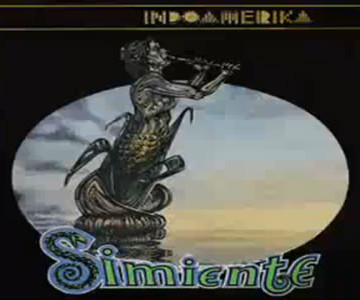
Simiente - "Indoamerika" {El Salvador} [1980] Andean Folk

at the end of 70s for cultural exchange some musicians from japan to usa visited el salvador, together they formed a band, simiente. this shortly lived band did two albums. when the war began at el salvador, other musicians turned back to their countries. album has the typical elements of andean folk in a nice atmosphere.

Sunday, April 25, 2010

Esa Helasvuo Q 1977

In 1998 an american college student in Boston, Mass. named Shawn Fanning invented a program to share the newly invented mp3 music files with friends in his dorm. He named it napster-- his own nickname, referring to his hair. He made it public in the summer of 1999 and pretty much changed the music world forever. He had no idea how huge his invention would become. For true music fans like me and probably everyone reading this it was like the heavens had opened up. After spending a lifetime buying records, cassettes, CDs (ironically, back to records now), to be exposed to such a wealth of riches and rarities was like being in a warehouse in imagination, like a platonic cave of shapes, a mathematician's universe with not just reality but all realizable entities in one place, like being in a planetary library of congress, like the famous ancient library of Alexandria maintained through the ages to now. What was really amazing was not to have so many well-known albums for free, but instead to be accessing rarities, out of print stuff, old soundtracks never rereleased. Those who had old records started to rip them, a simple cable from radioshack and a free program being all you needed. I scoured the record stores and sat by the record player recording to mp3. It was a time-consuming work and it felt a lot like a community service, since the rewards were so intangible-- a faceless person you’d never meet somewhere in the world could listen to your record instantly...

When Shawn invented his system he would never have foreseen that some people would hoard their rips and not share them, or that some people would leech records from others continuously, nonstop, without ever contributing to the pile. Of course according to mathematical game theory, this is inevitable in any complex process. There are cheaters who will evolve to take advantage of the trusting members of the group, there is a minority who remain extremely selfish, but as long as altruism persists in the majority, the system remains in an equilibrium.

Well I've been on both sides now, I've spent my life's income half on life, half on music. I’ve ripped records and hoarded, I’ve freely given and shared. But because there are so few of us who love this style, it now seems to me ridiculous to hold anything back. We should instead be trying to hold back the mediocrity that surrounds us. I am limited in time by real life and small children, but I think it is important to disseminate this music as much as possible, even if it means a number of people out there are stealing and leeching and not sharing what they have. Why is there music? You can't doubt that it evolved in humans along with all other culture, as a social bond, like humour and laughter. It is innately enjoyable for intellectual and mathematical reasons, as Pythagoras discovered so long ago, but its primary purpose, unquestionably, has been as a social strengthener, connector. Share freely, in the spirit of Shawn and napster. Now I'll stop the preaching.

Esa Helasvuo is one of the greats in Finnish jazz, here he plays with Vesala in Q from 1977. From dusty groove:

"Drum and piano duets -- handled in a really wonderful way! The core of the album features acoustic piano from Esa Helasvuo and drums from Edward Vesala -- both strong players on the 70s Finnish scene, jamming together here in a style that's always inside, and touched with modern piano experiments of the 60s generation that includes Bill Evans, Steve Kuhn, and Keith Jarrett -- with plenty of interesting tones and colors from Esa, supported by lightly snapping, almost melodic drums from Edward. But added to all of this are some gentle shadings from a small string section -- used in a way that almost recalls Charlie Haden's best string backings -- never intrusive, but just at the edge to inflect a bit more spirit to the tunes"

Again I have to mention the cover, what a work of art!! It just gives me chills to look at these beautiful covers.

Ornitologit...

Saturday, April 24, 2010

Magog. Haxmjolk. OP and the phantom band. Groep Ohm Skokian. Aardvarks. Atrium Color Seed. St Erhart paprika. Everybody's own hand.

The story goes like this. Somewhere sits the man who has almost everything. He spent years since the beginning collecting gems, since the dawn of mp3s and napster, the commonest through to the rarest. In a few years, he will have them all. Only a few remain elusive but thanks to the stupendous set he has assembled he's confident he’ll get the last remaining private pressings, even one-off albums like a legendary cassette or acetate recorded by a completely unknown yet brilliant band in the seventies, through trades and diligent searching. He is aided by a set of far-flung henchmen-- obscure toilers who purchase the records and rip them, then trade them, all unaware of the enormity of their task, like the Mesopotamian scribes who each knew only a part of the text they were working on. He is financed by a wealthy venture capitalist who is equally obsessed but more limited in time than money, to whom hundreds of dollars for one rarity are nothing in pursuit of the shared dream of owning all the historical progressive albums in the entire world-- which obviously constitute a mathematically finite set-- although approaching the exact number requires a calculus which should approach an asymptote, or limit, perhaps around an order of magnitude ten to the power 4, possibly 5, depending on definitions. Day by day he amasses more through the work of all, until one day he has everything-- though no one knows he has this power, this uniqueness in a world of almost seven billion humans. To be alone in such a possession is unusual, it is as special as being the richest man in the world. What does it mean if everyone is unaware? We are all alone in our own consciousnesses. Picture him working in the depths of a hospital by day, in the evening coming home to a package-- the last gem left to listen to. Surrounded by the discs of sound he is complete at least, task finished.

In quantum mechanics we speak of the wave function (which governs all subatomic entities and by extension all reality) 'collapsing' due to interaction with other processes. The elucidation of this collapse to this day is one of the mystifying aspects of the standard model. There is no complete theory to explain it, though many philosophical interpretations. Some, perhaps most physicists, believe that each event, governed by a certain probability, splits into a separate parallel universe. Thus the world and the future are indeterministic in a very deep and decisive manner. At that time the LHC in Europe, through a freak extremely improbable hadron beam black hole creation event, leads to a vacuum instability that is lower in energy than our current universe. The result (as was warned before many times before the accelerator came on line) is that at the speed of light a wavefront destroys the current structure of the universe and drops it to a lower energy vacuum of obliteration. Utterly lost in a millisecond are the man who has everything and his collection of everything.

But, in another earlier split parallel universe, the man who has everything sits back and relaxes after acquiring the last progressive album from Germany and picks up a book on the suggestion of a friend: Sir Martin Rees' "Our Final Hour." He reads about the doomsday argument-- the argument that we are all born, here and now today, because it is the statistically likeliest time for a human to be born (10 percent of all humans who ever lived are alive today), or to put it differently, the population is about to crash suddenly: we are in the middle of a bell curve-- and he's jolted into the chilled realization that humanity is in peril, time is short... He can't sleep anymore, it hits him over the head like a hammer. Of course, it's obvious, there is no future of traveling the stars and exploring galaxies, the population curve is about to negative slope soon... So he starts a blog and dedicates himself to sharing all his tens of thousands of hoarded gems with all the fans who can appreciate them, few as they are proportionately under the integral of that gaussian. He has just started, having shared Anubis (Fra 1984), when the aforementioned LHC vacuum instability wipes him out and all the other fans, atomizing and quantumly randomizing all the culture and progressive music humanity has ever created as well as that great record collection.

Addendum: the parable is not about me!!!!!!

Magog - Lock...
Häxmjölk - Eskimo Heat ...
O.P. & The Phantom Band....
Groep Ohm - Skokian...
Aardvarks - Aardvakistan...
Atrium - Vierwetterhaus...
St-Erhart - Cuando se come aqui...
Hand - Everybody's Own Hand...

Brave New World - Oh Calcutta!! 1970

This album is interesting, not because of the music, but because of the story behind it-- forget the music, it’s rubbish. Oh Calcutta was a musical which featured all nude performers. As expected, it was a sensation, since it was the first such nudist live act or one of the first. Think about how shocking that must have been back in the late sixties before there were strip clubs and video stores on every big suburban city block. Even now it’s a little risqué to think you’d force your whole cast to perform naked, as a producer. And what kind of audience are you looking to attract??

I’m surprised to see how many soundtracks were released from the same musical. Obviously that testifies to how popular it was. This one is notable in my opinion because its cover is such a remarkable Magritte-like work. The cover really is everything with this record today, although there is such a history behind it. Here are some excerpts from the write-up on wikipedia to give you an idea.

"It ran in London for over 3,900 performances, and in New York initially for 1,314. Revivals enjoyed even longer runs, including a Broadway revival that ran for 5,959 performances, making the show the longest-running revue in Broadway history.

The title is taken from a painting by Clovis Trouille, itself a pun on "O quel cul t'as!" French for "What an ass you have!".

Peter Schickele (aka "PDQ Bach"), Robert Dennis and Stanley Walden were the revue's composers.

An excerpt from a sketch:

A boy and a girl who just met are in their own playland, with the boy constantly trying to find ways to seduce the girl who is afraid of him because he's a boy. The girl is eventually raped by the boy at the end of the sketch and is comatose from the experience ("Jack & Jill")."
( --I think all of you will have the same reaction as me— “What the +++ ????”)

Anyways, this record sells for a lot of money. Whatever possessed me to buy it???
Like so many of these vinyl artefacts, the price has nothing to do with the quality of the music, everything to do with reputation and rarity and record shops. In the days before mp3s it was perhaps a cheat tactic to sell these with a caveat emptor, the buyer had no idea he was being ripped off. Nowadays of course we can listen beforehand and decide for ourselves if we want to buy the vinyl. What other art genre can you overprice like this? I have never heard of a great novel being sold for a lot of money, in fact, you can get them free at the library and I usually see Charles Dickens selling for a couple bucks at barnes and noble. In art the high price for van goghs is a reflection of how much we value his art, it would be like paying millions for Genesis' Selling England album, which in theory is what it is worth. In any case we can go to museums, galleries, or buy a book of his paintings. Otherwise, we might as well be stamp collecting, where rarity defines price, not quality.

Oh! Calcutta!...

Friday, April 23, 2010

Mixture (US 1980)

This album is for the mighty osurec who has laboured so amazingly to unearth lost treasures from the north american continent of 30-40 years ago with the archaeological skills of a trojan Schliemann in the gold vinyl racket, time and again chiseling out lost species of dinosaurs out of the badlands for exhibit online.
As one who has gorged myself at his trough like a hippo at a mud-bathing watering hole swatting away the flies of real life at the apex of hours of prog fulfillment and satiation I think it's important to acknowledge his incredibly generous services.
This is another private-pressed american record, lost without a trace seemingly in the sands of time, of the jazz-rock genus. A type as common in those days as the trilobites in the paleozoic and apparently as outdated. Similar to Esagono Vicolo in the ingeniousness of some chord changes, patterns, and the mix of rock and jazz.

Check out the beautiful drawing on the cover.

Sicilianska frojder...

Thursday, April 22, 2010

(Mike Hugg) Hug - Neon Dream 1975

Here's a treat for all those who like the latter half of the progressive rock continuum, a fantastic lost album of funky-ass rock with the prog dial turned low, but with just enough heat to give us that caffeinated kick we addicts love. Reminds me a lot of the albums featured on the growing bin, such as the just released mystic syster (and I say that with total respect and awe with regards to his work). You'll love this 1975 output of excellent songwriting full of fast throbbing funk and synth solos, odd greek scales starting off into explosive dancing energy, unusual modulations, chords, singable hooks, boosted with enough energy to power a ford pinto on a round trip from new mexico to the moon (the fake moon landing in the nevada desert, that is). In terms of comparisons, reminds me a lot of public foot the roman or neutrons but with more funkishness. Very typical for this period in anglo-prog, the sunset of the great age of progressive music for england and english-speaking countries, 1969 to 1976. I think it's around at this point that the first inklings of punk started to blast away our treasured type. Here's the full info on this little lost (no more) gem:

"Mike Hugg was, with Manfred Mann himself, the longest surviving member of the group known as Manfred Mann. Born Michael Hug in 1942, he came of age in England during the early '60s as a jazz enthusiast, leading his own quartet, which, in addition to himself on drums, included organist Graham Bond in its lineup. Hugg managed to hook up with South African-born pianist Manfred Mann while playing at Butlin's, the English holiday resort, in 1962. The two took a liking to each other and formed the Mann-Hugg Blues Brothers, which became the core of the group that was eventually christened Manfred Mann, featuring Hugg on drums and percussion. Much of Hugg's career for the next decade was linked to Manfred Mann as bandmate and frequent collaborator as a composer. Apart from their work together in the band, the two were responsible for writing and producing a great deal of film music (Up the Junction, Venus in Furs, etc.) and television music, as well as commercial jingles, although Hugg also emerged as a highly successful songwriter in his own right in 1966, when a composition that he'd written with his brother Brian, "You're a Better Man Than I," became a hit for the Yardbirds.

When the group Manfred Mann split up in 1969, Mann and Hugg remained together, forming the more progressive jazz-rock outfit Emanon, which later became Manfred Mann Chapter III. After parting company with Mann in 1972, Hugg cut a pair of solo albums, Somewhere and Stress and Strain, for Polydor, on which he switched from drums to keyboards. He formed the quartet Hug in 1975, which cut one LP, The Neon Dream -- a strange mix of funk and progressive rock -- and then the Mike Hugg Freeway, which only ever released one single, in 1976. Hugg also played piano and organ on Lo and Behold by Coulson, Dean, McGinnis, Flint, which was produced by Mann. He has written some movie and television music (including the original theme for the British television show Minder). In the early '90s, Hugg was reunited with his former Manfred Mann bandmates Paul Jones, Mike Vickers, and Mike d'Abo, for what was supposed to be a one-off event promoting a hits compilation, but proved to be so musically satisfying that it became a regular part-time gig. The Manfreds, as they became known, have delighted audiences around the world with their revival (and expansion) of the old repertory, which has allowed Hugg to keep his hand in performing and jamming as a keyboard player. " ~ Bruce Eder, All Music Guide

As an addendum, I would say I find this album much more interesting and enjoyable than the MM albums, which are more poppy and simpler. Link to follow shortly...

Star Traveller...

Wednesday, April 21, 2010

Nordvision 1975

I've thought a lot about why these albums from the seventies were so good, so incomparable and unique, when side-to-side you listen to earlier and later artistic periods. Of course some people will disagree right off the bat. I think it boils down to exposure, the musicians from that time grew up educated in classical music, almost invariably, and often knew jazz very well. The early environment was so different from what young musicians today grew up with. Then, when rock came around, it was still new and there was a willingness to play with it that is absent today except in the progressive scene itself, which is old enough that nowadays a musician doing this style is really just imitating past masters. Rarely do we hear them combine all three streams, jazz, rock, and classical into one harmonious whole. There is a demographic explanation too which I think should not be dismissed, this was the peak creative years of the infamous baby boomers. In fact I think at the time, the average age over the entire globe was in the 20s -- it was a young world back then (compared to late 30s to 40s in the western world now.) I think demographics at least explains why there has never been a band as popular and creative as the beatles. Then my friends the peak oil people will say that the seventies were the height of energy availability per capita and overall well-being.

Well it's obvious what I'm leading up to here: on a basis of folk rock and folk music from northern europe, the musicians, which include the famous Mats Vinding on bass, incorporate a lot of jazz elements, and some classical, baroque compositions. There is nothing awkward about the melding, which is why I think this album is fantastic. A couple of tracks feature some gorgeous electric piano, one in particular starting with a strange melody in F minor transitions a couple of times before, in the middle part, turning into a 70s soundtrack sound in D major, complete with spacey female voice wordlessly singing lalala (think rosemary's baby or emmanuelle). Several tracks start acoustic and turn electric in a wonderful way.

"The concept behind their album was to give a new twist to traditional Nordic folk songs from Sweden, Denmark, Norway, Iceland and Finland. All 11 tracks are tastefully arranged instrumentals (with acoustic and electric guitars to the fore) with strong jazz influences, almost like Björn J:son Lindh's records stripped of the flute (which really is inconceivable). Not really progressive music, nevertheless displaying hummable melodies and supreme instrumental competence. (S.G.M.)"
I disagree with the last remark, if this isn't progressive I don't know what is. It may be the writer was put off by the baroque and folk basis, but the songs sure get pretty ingenious and interesting.

Please enjoy this little example of pure seventies beauty. Any comments (negative or positive) regarding what I've written are appreciated!

I Min Ungdom Det Gladde Mig...

Wednesday, April 14, 2010

Human. Un certain pays. 1985.

Overture: a certain land in the near future. Among the ruins of industrial civilization (everywhere plastic home depot bags and starbucks cups) people scrounge for leftover tomato soup cans, and lawns with dandelions to eat or the last ounce of petrol in the bottom of deep pits dug into the sites of old gas stations. In the dark, treeless, concrete infested parts of the land people swollen close to starvation, survive like vultures on the already gone. Then they celebrate by taking a flatscreen plasma tv and smashing it on the ground to see the sparks. Not a single cat or dog or squirrel is to be seen here.

Ricochet: an alien spaceship flashes by, slingshotting around the sun like a comet, long tail of fusion carrying it towards the land. Inside they watch a Nat Geo video of the forests of indonesia teeming with orangutangs.

Amalgame: One intrepid human manages to grind maple seeds into flour with an elliptical machine. Another is seen to slice and dice some grass and water into soup, but it quickly breaks. One is chopping up pigeons with a lawnmower. Another marks his territory with a printer toner cartridge, getting it all over his True Religion Jeans. He curses, takes a bite out of a kraft "fun cheez shapes". Still tastes good, centuries after it was made! Another human is vacuuming up ants from the sidewalk to eat with a still-working dustbuster with batteries. When the batteries run out soon he uses it to dig himself a home in the ground. Another walks by with rotten crabapples in a wheelbarrow made of a small filing cabinet on top of two large rolodexes full of important business contacts. One pulls in a fishing net with 2 dead oysters, no fish, with rope made of linked rolex watches. Next to him, a woman with several toilet plungers is catching tiny crawdads.

Depression: Time has passed, but badly. Few are left by now, scraping by on the last pizza pockets and whole foods granola mix bins forgotten by the others. Thank god they didn't like the mix, they say to themselves. Mothers cry as they watch their children die before their eyes, reaching to give them a plastic waterproof Thomas the Tank Engine in comfort. They give them sweet splenda packets to suck not realizing it has zero calories and will not sustain them.

Albatros: Everywhere birds-- mostly pigeons and sparrows-- fill the sky. The age of dinosaurs passed to the age of mammals, which has now ended, but the age of birds is now set to start. An albatross lands outside a shelter made of lego. Inside the last couple left alive looks out. He throws his golf putter weapon towards it but misses: "oh damned sport!" he says next, activating a golf ball shooting machine, but of course, the balls bounce harmlessly off the bird. Instead the bird starts to peck at the too weak to move woman clothed in tattered Furstenberg head to toe. It turns away disgusted by the taste of her recycled-plastic crocs.

Hiver: The aliens armed with impossibly powerful laser guns land from their ship, millions strong, to conquer what years ago they saw was a green and fertile land of forest and fish-filled seas, ready to enslave the population just like the conquistadors did with the natives of the new world. Instead there is nothing left alive to enslave. The leader kicks away a still-working ipad in disgust. "Not even any fossil fuels left here..." he-she says. His-her second in command comments: "How ironic... They escaped their fate, through self-destruction." The leader promptly shoots him dead. He hates irony, as indeed all good leaders should.

This album is a bona-fide masterpiece. As I've mentioned before, and repeated before, again and again, someone spent a lot of time writing this music, and it shows. What makes it great is the quality of the composition and the cohesiveness of the whole, it plays out like a long symphony, the pieces connect together perfectly. A digital piano performs like a concerto with a very odd sounding orchestra full of echoes and soundtrack effects, occasionally even duetting with an acoustic grand. The orchestra is not annoying in the way for ex. The Enid's is, because it is subjected to so many effects like reverb and because thankfully the string section has been given the day off to brush up on their dumb mozart. Very dramatic crashes of brass and woodwinds and punctuations of huge chords make for a really interesting auricular experience. There is no guitar at all. The melodies are very original, sounding like my man Igor S trying to create a rock album. The dark, very characteristically pessimistic style of advanced french prog is in evidence here, like Yves et Alain Lorentz, Shylock, Yog Sothoth, Carpe diem. The closest similar album is probably British Craft from the eighties, or russian Horizont's two albums, whose digital piano use is very similar. It's shocking this came out in the 1980s, at the same time as Duran Duran et al. What were these musicians thinking?? Thank god they couldn't have cared less about the zeitgeist of dance dance dance and I want my MTV and neon green short shorts...

L'albatros...

Tuesday, April 13, 2010

De L'onde a L'infini (Canada1974)

The ondes martenot were invented by (who else) Maurice Martenot in 1928, one of the first electronic instruments created. The sound is very similar to the theremin: eerie, soundtrack type stuff, and is mostly associated with Olivier Messiaen, who went overboard with it in the early twentieth. The sound is actually produced by oscillations in vacuum tubes, believe it or not. A vacuum tube was a big glass tube that functioned the same as one transistor -- just one. I remember my dad's big laptop-sized homemade radio made of vacuum tubes, one of which would blow like a light bulb every time you turned it on. In Canada, Quebec has long had a tradition for playing and using this instrument. So, in 1974 a group of classical composers worked together to create a more accessible introduction to the instrument and compositions for it for popular enjoyment. Considering the degree of open-mindedness and willingness to experiment in music in the early 70s this idea was not as crazy as it seems today.

The instrument is still played and practiced in France, though it is considered a historical curiosity, its rarity due mostly to the legendary difficulty of playing the instrument -- it uses a normal keyboard, there is a sliding ruler or ring worn on the finger which is used for vibrato or glissando effect, but no sound is produced until yet another set of controls is pushed to increase volume. Sounds ridiculous? I think so, and today we would have no patience for an instrument like that, especially considering it is not quite as pleasurably melodious as the mellotron, which few can resist.

On this record Sylvette Allart plays the ondes, backed by piano and harp. Four classical composers, including the famous Dompierre (who wrote soundtracks for Quebec films), Eduard Michaels, Georges Guinot, Luc-Andre Marcel contribute pieces which they wrote in the past (mostly from the 50s). The compositions range widely, overall level is comparable to the earlier posted Giuntoli and Mertoli on this blog, or more well-known Julverne, Conventum, bearing in mind the unusual instrumentation, i.e. chamber progressive. The first composition by Dompierre is a sonata with some ravel movements around a very beautiful rachmaninoff like middle adagio movement. Eduard Michaels contributes a gorgeous piece called "Through a small window" a duet with harp I think. Several pieces relate to birds, which I believe is an homage to Messiaen's obsession with ornithology.
The last, "l'oiseau de java" is the standout virtuoso piece, using many ondes together, making the instrument sound at different times like flutes, violins, cellos, bassoons, clarinet, and that crazy lady who plays variously-filled wineglasses with her fingers.
Check out the review from rateyourmusic (which actually misses the point of the album entirely):
"Who would've thought that after so much crate-digging, after enormous efforts that the ProgQuebec label is doing to promote the progressive music of the French-Canadian scene of the 1970s, there'd still be treasures to unearth in this particular region? And then out of the blue appears this little gem of an album, full of chamber rock elegance and weird experimental twists..."
In fact it's not out of the blue, being very much a part of modern classical music, but I agree that it's shocking that crate-digging still produces such amazing gemic surprises for us fans.

As I've said before the abandonment of this beautiful music is a tragedy for the world and human culture which has become swamped in mediocrity-- think of how many fewer people, especially proportionate to the current population, can enjoy this now, than did in the seventies when it appeared. One in a million people? Ouch. This is why I think it's really imperative for all of us fans to share this music as much as possible with each other and the outside world... We should not be hoarding this like gold. Shame on those of you who do! There are so few of us! Our only hope is that, like the monks in the middle ages, we can keep the flame alive until a time when people will rediscover and reappreciate the incredible ingenuity and mastery expressed in this artform, like the writings of the classical poets and playwrights copied by hand by the same monks who invented champagne and my favourite, dark Chimay. God bless those trappist monks! But I doubt that moment will ever come. So let's have a leffe brune and listen to this now.

L'oiseau de Java...